


 Global
 United States

 Japan





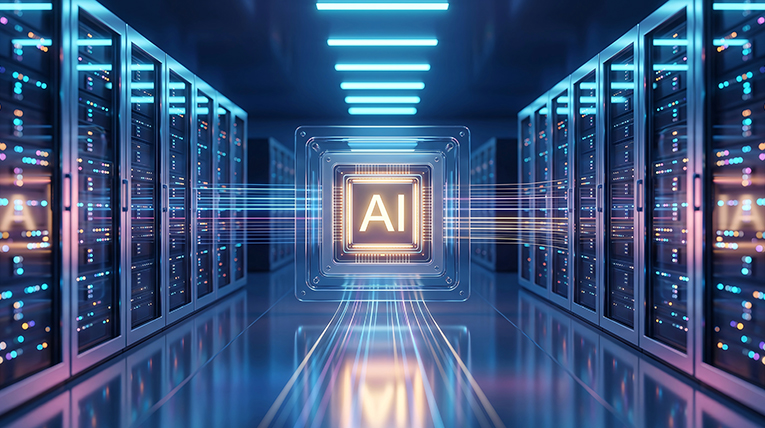
Artificial intelligence is transforming how data centres are designed, deployed and operated. The growing adoption of AI inference, computer vision, generative AI and real-time analytics is driving demand for accelerated compute, low-latency processing, high-performance networking and distributed infrastructure.
At the same time, AI workloads are becoming increasingly heterogeneous, spanning CPUs, GPUs, NPUs, DPUs, containers, virtual machines and specialized edge hardware. Managing these environments requires more than high-performance hardware. It requires software that connects applications, infrastructure, data, orchestration and operations into a cohesive system.
Software engineering provides the foundation for making AI data centres observable, automated, intelligent, resilient and scalable.
VVDN brings together software, AI, cloud, infrastructure and hardware engineering capabilities to address these requirements across the AI data-centre stack.
Table of Contents
Building Software-Defined AI Data Centre Infrastructure
Traditional infrastructure management often treats applications, operating systems, networking, storage and hardware as separate domains. However, AI workloads depend on all these layers working together.
For example, increased inference latency may originate from GPU resource contention, network bottlenecks, inefficient workload placement or infrastructure configuration. Resolving such issues requires visibility across the application and infrastructure stack.
A software-defined approach connects these layers through integrated interfaces, automation and monitoring.
How VVDN contributes: VVDN’s software engineering capabilities span application development, cloud and infrastructure engineering, operating systems, kernel and driver development, firmware and hardware integration. This cross-layer expertise supports the development and integration of software-defined infrastructure tailored to specific AI workloads.
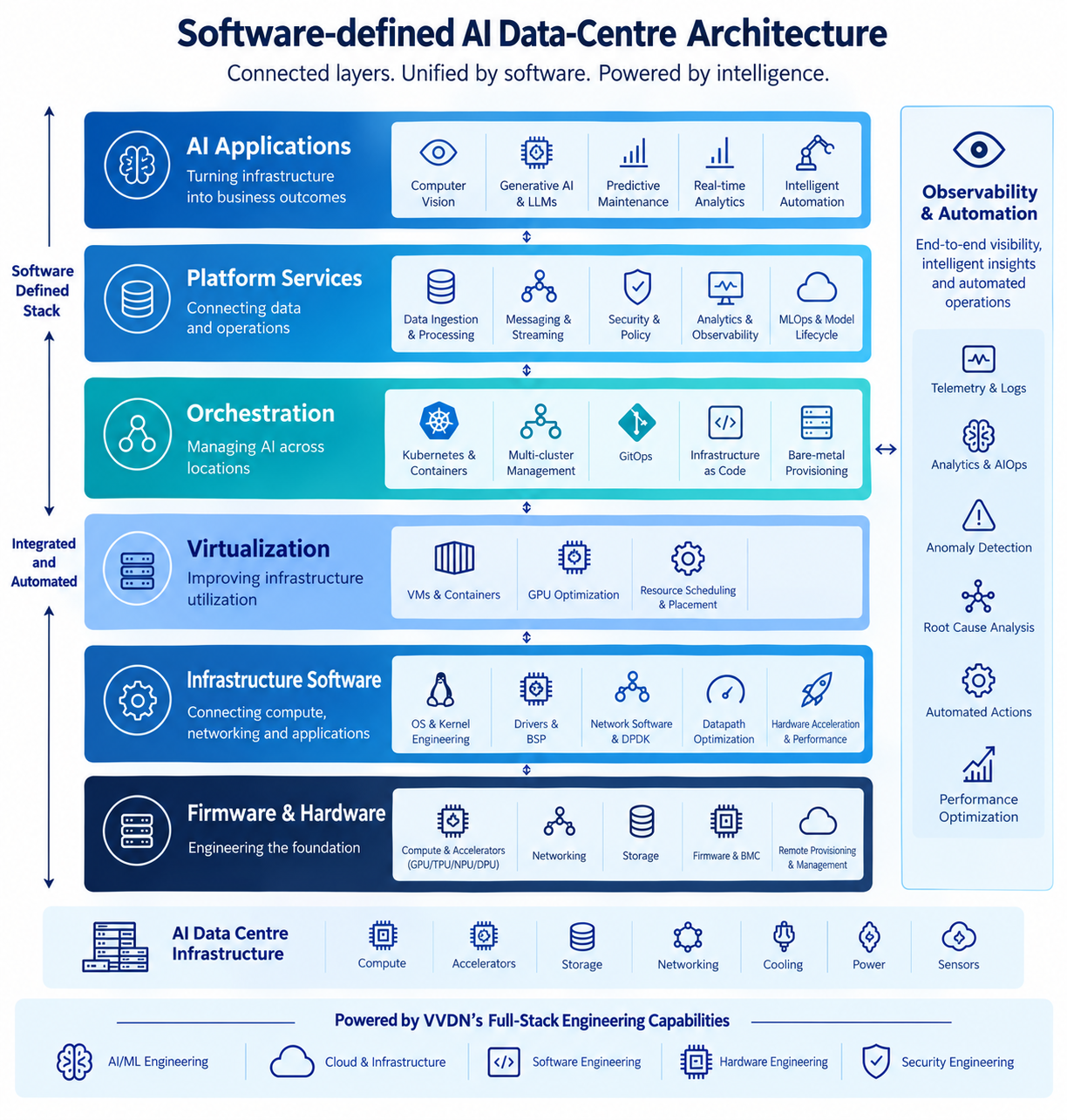
The Six Layers Behind an Intelligent AI Data Centre
An AI data centre is a connected ecosystem in which applications, platforms, orchestration, infrastructure software and hardware work together to deliver AI-driven outcomes. Software engineering connects these layers to improve workload management, performance, reliability and scalability across data-centre and edge environments.
1. AI Applications: Turning Infrastructure into Business Outcomes
AI applications enable use cases such as video analytics, predictive maintenance and generative AI (GenAI) through integrated models.
2. Platform Services: Bringing Data and Operations Together
Data pipelines, messaging, APIs and analytics bring application and infrastructure data together, supporting observability, security and operational insights..
3. Orchestration: Managing AI Across Locations
Orchestration automates workload deployment, scheduling, scaling and updates across data-centre and edge environments.
4. Virtualization: Making Infrastructure More Flexible
Virtualization and container technologies enable flexible resource allocation, workload isolation and improved compute and GPU utilization.
5. Infrastructure Software: Connecting the Technology Stack
Operating systems, kernels, drivers, firmware and network software connect applications with hardware to improve compatibility and performance.
6. Hardware & Management: The Foundation of AI Infrastructure
Compute, GPUs, networking and storage provide the foundation for AI workloads, supported by software for health monitoring, remote maintenance and fault detection.
From Observability to Intelligent Operations
Modern AI data centres need to go beyond simply detecting problems. They require visibility into application performance, GPU utilization, network latency and workload behaviour to identify potential causes and anticipate issues. By correlating application insights with infrastructure telemetry and AI-driven analysis, organizations can move from reactive monitoring towards proactive and automated operations.
How VVDN contributes:
VVDN’s capabilities in observability, data analytics, anomaly detection, automated root-cause analysis, predictive alerting and resource optimization help organizations move towards more proactive and intelligent infrastructure operations
AI-Driven Operations and Architectures for Diverse Data Centre Environments
AI is transforming both data-centre operations and the software engineering processes behind them. Engineering teams can use AI-assisted workflows for code review, log analysis, incident investigation, root-cause analysis and documentation. Combined with automated CI/CD pipelines, these capabilities help streamline software development, testing, release validation and infrastructure operations.
AI data-centre architectures must also be tailored to workload, scale, connectivity, latency and data requirements. Industrial edge deployments support applications such as visual inspection, predictive maintenance and worker safety, while telecom edge and MEC environments enable low-latency 5G, O-RAN and real-time applications. Enterprise private edge clouds support data sovereignty, private AI, RAG, internal copilots and engineering workloads. Each environment requires an appropriate combination of compute, AI acceleration, orchestration, networking and software capabilities to deliver efficient and scalable AI infrastructure.
The Value of Full-Stack Engineering
AI data centres require coordinated engineering across applications, platforms, orchestration, infrastructure software and hardware. Application performance depends on infrastructure resources, while effective infrastructure management requires visibility into workloads and application behaviour. Hardware components, in turn, need reliable software interfaces, drivers and management mechanisms.
Full-stack engineering connects these dependencies, helping organizations integrate components, troubleshoot performance issues and optimize AI infrastructure as a unified system.
VVDN’s Software Engineering Capabilities for AI Data Centres
VVDN brings software, AI, cloud, infrastructure and hardware engineering capabilities together to support AI data-centre environments across the technology stack.
- AI & Application Engineering
VVDN supports the development of AI applications that combine machine learning, computer vision, real-time inference and LLM/SLM integration. Our engineering expertise also helps optimize and package models for deployment across cloud, data-centre and edge environments.
- Platform Engineering
VVDN develops software capabilities for data ingestion, messaging, streaming, analytics and observability. These capabilities help bring together application and infrastructure data, enabling better operational visibility, security and lifecycle management.
- Cloud & Infrastructure Engineering
VVDN supports the deployment and management of AI infrastructure through Kubernetes-based orchestration, multi-cluster management, GitOps, virtualization and GPU optimization. These capabilities help organizations manage workloads consistently and use infrastructure resources more efficiently.
- Infrastructure Software
VVDN’s expertise spans board support packages, operating systems, kernel and driver development, firmware, network software and hardware integration. This enables software to work closely with underlying compute, accelerators and networking components to meet workload-specific requirements.
- AI-Powered Operations
VVDN combines AI-assisted software engineering, automated testing, observability and operational analytics to improve development and infrastructure management. These capabilities can support anomaly detection, root-cause investigation, predictive alerting and more efficient CI/CD workflows.
VVDN’s engineering portfolio includes software platforms and accelerators that support AI data-centre deployments. Intelligent Cloud Engine (ICE) enables secure device connectivity, cloud data management and analytics, while Intelligent Network Controller (INC) enables centralized network monitoring, management and automation. SFIT supports AI-powered software testing, while VISTAR provides security capabilities to help address application and infrastructure security requirements. These capabilities complement VVDN’s broader engineering expertise in cloud management, network intelligence, software testing and security
Conclusion: Engineering the Intelligent Data Centre
AI is transforming data centres into programmable, distributed and intelligent computing environments. Their success depends not only on compute capacity but also on how effectively infrastructure can be engineered, provisioned, orchestrated, observed, optimized and automated.
Achieving this requires software engineering across the entire stack—from AI applications and platform services to orchestration, infrastructure software, firmware and hardware. Integrated engineering helps organizations build AI data centres that are scalable, resilient and suited to diverse workloads.
VVDN brings together software, AI, cloud, infrastructure and hardware engineering capabilities to help organizations develop the next generation of AI-ready data-centre infrastructure.
Build Your AI Data Centre with VVDN
Explore how VVDN’s engineering capabilities can support your AI infrastructure requirements, from application development and cloud orchestration to infrastructure software and hardware integration.