





 Global
  United States
 Japan
Japan 






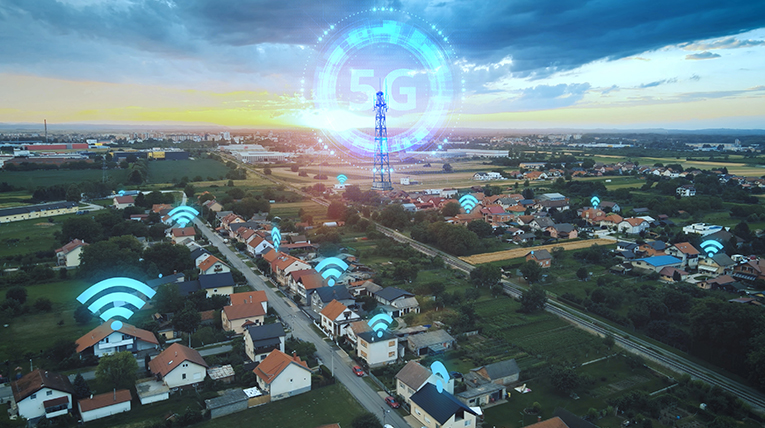
We all know the pain of slow internet, long waits for fiber installation, and high costs for last-mile connectivity. In many urban pockets and vast rural areas, laying fiber is not only expensive but often impossible in the short term. People want high-speed, low-latency broadband now, not later.
Meanwhile, enterprises managing hybrid work, schools streaming 4K lessons, and smart homes demanding multi-device connectivity are calling for better solutions. Traditional wired broadband is struggling to keep up, especially outside dense cities. This is where 5G Fixed Wireless Access (FWA) comes in, turning wireless networks into credible broadband alternatives without digging up streets.
Table of Contents
Understanding the Technology and Key Components
So what exactly is 5G FWA? Let us break it down in simple terms.
- Fixed Wireless Access (FWA)
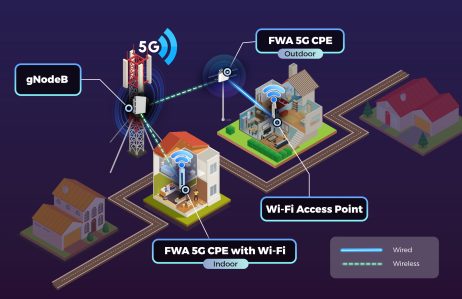
Instead of connecting homes and offices with physical cables, FWA uses wireless 5G signals to deliver broadband. Think of it as supercharged Wi-Fi that does not rely on copper or fiber, riding 5G airwaves straight to your doorstep. - CPE (Customer Premises Equipment)
This is the device installed at your location, acting as the gateway between the 5G network and your local Wi-Fi or wired devices. It comes in indoor and outdoor variants:
Indoor CPE is placed inside the premises. It receives 5G signals directly and delivers internet to all internal devices.
Outdoor CPE is installed on rooftops or exterior walls. It captures 5G signals from the base station and passes them via a wired connection, such as Ethernet, to an indoor unit, which then distributes connectivity throughout the premises.
- gNodeB – The 5G Base Station
The gNodeB is a crucial component of 5G networks, providing high-speed wireless internet to homes and businesses without relying on wired connections. It communicates directly with the CPE, managing signal transmission, radio resources, and mobility. By enabling advanced 5G features such as higher data rates, ultra-low latency, massive IoT connectivity, and network slicing, the gNodeB ensures reliable, efficient, and scalable performance in both urban and remote areas. - Wi-Fi Access Point
Inside the home or office, the CPE connects to a Wi-Fi access point, distributing broadband to devices such as laptops, phones, smart TVs and IoT devices without the need for wired connections.
Why 5G FWA CPE Matters: Advantages
- High-Speed Broadband Without the Cable Chaos
Users get ultra-fast internet, often comparable to fiber, without laying cables. For many, 5G FWA is now the best alternative to wired connections. - Lightning-Fast Setup
No trenching or long fiber wait times. Installation can be completed in hours instead of weeks or months, making it ideal for new homes, remote villages, pop-up offices or temporary events. - Massive Scalability
Operators can deploy FWA in dense urban areas as well as remote locations without digging up streets, accelerating digital inclusion across cities and rural regions. - Enterprise-Grade Reliability
With 5G standalone setups and advanced radio technology, FWA supports video conferencing, cloud applications, IoT devices, and critical business traffic, not just casual browsing. - Future Ready with AI and Reduced Capability
AI capabilities within 5G FWA CPE improve performance and connectivity quality. RedCap or Reduced Capability variants enable efficient, cost-effective deployments for devices that do not require full 5G capabilities.
Numbers That Show the Momentum
- Market Value Explosion
The global 5G FWA CPE market was valued at USD 3.67 billion in 2025 and is projected to reach nearly USD 7.96 billion by 2027. Over the next decade, it could surge to USD 176.24 billion, representing an approximate CAGR of 47%.
Source: Link - Regional Adoption Trends
North America and India lead in 5G CPE shipments, with 93% and 92% respectively being 5G-enabled devices. Asia-Pacific accounts for approximately 35% of shipments, indicating strong global demand.
Source: Link - Shipment Growth
In 2024, 5G FWA CPE shipments reached 16.8 million units and are expected to hit 20.1 million in 2025, accounting for over half of all FWA shipments globally. Total global shipments could reach 35.3 million units in 2025, reflecting a 26% year-over-year growth.
Source: Link
Future Outlook: What Is Next
- 5G Advanced and Beyond
Emerging 5G-Advanced enhancements will further boost FWA capabilities, delivering higher throughput, smarter networks and improved energy efficiency. - Smart Homes and Smart Cities
With AI-Powered Wi-Fi 7 and 5G combined, homes and offices will support dozens of devices, including VR headsets, AR glasses and smart appliances, without connectivity bottlenecks. - Multi-Spectrum Growth
Operators will leverage sub-6 GHz for coverage and mmWave for ultra-high speeds, enabling multi-gigabit broadband even in areas without fiber. - Digital Inclusion and Rural Internet
FWA will play a key role in bridging the digital divide by delivering broadband to communities where fiber cannot reach.
VVDN: End-to-End 5G FWA CPE Solutions
VVDN is a trusted partner for global OEMs and Telcos, delivering complete 5G FWA CPE reference design solutions with agility and precision. We excel in RF and antenna design, ensuring reliable connectivity, and offer cross-platform chipset expertise to accelerate product development.
Our in-house testing labs validate performance and quality, while mechanical design capabilities ensure robust enclosures for both indoor and outdoor deployments. From product engineering to manufacturing, VVDN delivers tailored solutions to meet diverse project needs. Additionally, VVDN offers ready-to-use 5G FWA CPE indoor and outdoor reference designs, enabling OEMs and Telcos to achieve faster time-to-market.