






 Global
  United States
 Japan
Japan 






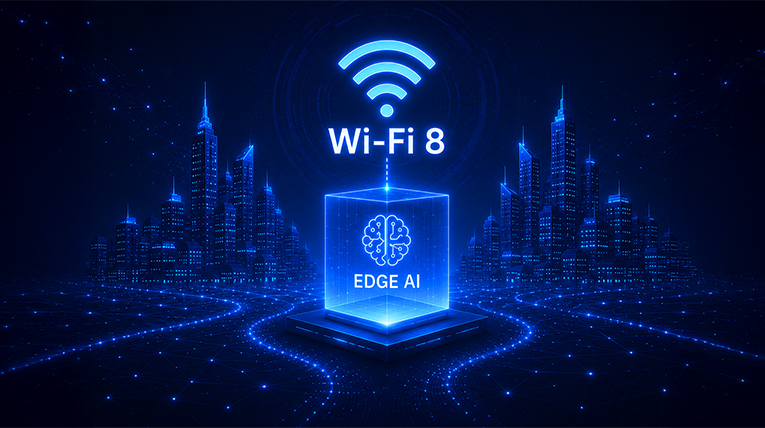
What Happens When Networks Start Thinking for Themselves?
Each generation of Wi-Fi has delivered higher throughput and support for more connected devices. Wi-Fi 6 and Wi-Fi 6E improved efficiency in dense environments, while Wi-Fi 7 advanced bandwidth and latency. As wireless networks become the foundation for AI-powered applications, industrial automation, mission-critical IoT and connected devices, expectations are shifting from speed to predictable performance.
Organizations now expect video conferences to remain smooth during congestion, autonomous robots to maintain seamless connectivity while roaming, and AI applications to receive consistent, low-latency network access. Meeting these expectations requires more than advanced radio technologies. Networks must continuously analyze operating conditions, recognize changing traffic patterns and adapt in real time.
This is where Edge AI complements Wi-Fi 8. By bringing AI-driven intelligence closer to the network edge, it enables faster, context-aware decisions that optimize performance, improve reliability and enhance the user experience.
Table of Contents
The Wi-Fi 8 Foundation: Building for Predictable Performance
Unlike previous generations focused primarily on throughput, Wi-Fi 8 is built around Ultra-High Reliability (UHR).
To achieve this, Wi-Fi 8 introduces technologies such as:
- Multi-AP Coordination
- Coordinated Beamforming (CO-BF)
- Coordinated Spatial Reuse (CO-SR)
- Coordinated Time Division Multiple Access (CO-TDMA)
- Non-Primary Channel Access (NPCA)
Together, these innovations improve spectrum utilization, reduce interference, minimize latency variation, and enhance reliability for more predictable wireless performance.
These capabilities strengthen wireless performance across enterprise, industrial, public, and smart environments where connectivity directly impacts operations.
However, even a highly reliable infrastructure cannot respond to every network condition. Dynamic enterprise environments require intelligent, real-time decision-making beyond static policies.
Why Wi-Fi 8 Needs Intelligence
Modern wireless networks support diverse devices and applications with varying performance requirements.
AI assistants generate bursty traffic, collaboration platforms require low latency, IoT devices demand reliable connectivity, and industrial automation depends on uninterrupted communication. At the same time, software updates and background services compete for network resources, causing conditions to change rapidly.
To deliver Wi-Fi 8’s predictable performance, networks must continuously analyze application requirements, device behavior, traffic conditions, and radio environments. Edge AI brings intelligent decision-making closer to the network by running AI models on edge servers, wireless controllers, secure gateways, access points, and other edge computing platforms, enabling real-time optimization with minimal latency.
But how does Edge AI help Wi-Fi 8 achieve this?
How Edge AI Turns Wi-Fi 8 into an Intelligent Network
Wi-Fi 8 provides the foundation for predictable wireless performance, while Edge AI continuously monitors, analyzes, and optimizes network operations.
By analyzing traffic patterns, applications, connected devices, network telemetry, and anomalous behavior at the edge, AI enables faster, real-time decisions that help networks adapt to changing conditions while maintaining a consistent user experience.
The following four intelligence layers demonstrate how Edge AI enhances Wi-Fi 8 and moves enterprise wireless networks closer to autonomous operation.
Four Ways Edge AI Enhances Wi-Fi 8
- Traffic Intelligence: Prioritizing What Matters Most
Not all network traffic has the same requirements. Video conferencing, AI workloads, industrial control systems, and other real-time applications are far more sensitive to latency and jitter than downloads, updates, or bulk transfers.
Using Edge AI, the network continuously analyzes traffic characteristics, device context, and application needs to classify flows and prioritize critical workloads dynamically. Combined with Wi-Fi 8’s improved reliability and spectrum efficiency, this ensures consistent performance during congestion, keeping latency-sensitive applications stable without impacting lower-priority traffic.
- Application Intelligence: Making Networks Application-Aware
Bandwidth alone does not guarantee user experience. Enterprise networks must understand application performance needs and allocate resources accordingly.
Edge AI continuously analyzes application traffic, device context, and usage patterns to infer requirements and identify business-critical workloads. This enables policy-driven prioritization so collaboration tools, mission-critical SaaS, and AI workloads receive the required resources while lower-priority traffic is managed efficiently.
Combined with Wi-Fi 8’s predictable foundation, this delivers more consistent performance across diverse applications.
- Endpoint Intelligence: Optimizing Connectivity for Every Device
Enterprise and residential networks support a wide range of devices, including smartphones, laptops, cameras, sensors, industrial systems, and AI-enabled endpoints.
Edge AI analyzes device behavior, communication patterns, and performance needs to classify endpoints and understand their requirements. This enables better resource allocation, more efficient airtime usage, and device-specific policies.
Combined with Wi-Fi 8’s coordination and reliability improvements, endpoint intelligence helps efficiently support growing device diversity while maintaining consistent performance.
- Network Intelligence: Proactive Anomaly Detection and Assurance
Traditional network operations are reactive, with issues identified only after users experience degradation.
Edge AI continuously analyzes telemetry and behavior to detect deviations from normal patterns. This enables early detection of roaming issues, interference, latency spikes, and connectivity instability before they impact users or operations.
By enabling proactive insights and root-cause analysis, Edge AI strengthens Wi-Fi 8’s Ultra-High Reliability vision and shifts networks from reactive troubleshooting to proactive assurance.
The Journey Toward Autonomous Networks
The significance of Wi-Fi 8 extends beyond wireless innovation to how it works alongside Edge AI. While Wi-Fi 8 provides a reliable foundation through Ultra-High Reliability (UHR), Multi-AP Coordination, and improved spectrum efficiency, Edge AI enables intelligent, real-time decision-making at the network edge.
Together, Traffic Intelligence, Application Intelligence, Endpoint Intelligence, and Network Intelligence create more adaptive, self-optimizing networks that reduce manual intervention while improving the user experience and operational efficiency.
Although fully autonomous networks are still evolving, the convergence of Wi-Fi 8 and Edge AI marks a significant step toward networks that continuously monitor, learn, adapt, and optimize themselves.
Accelerating Wi-Fi 8 Innovation with VVDN
The future of wireless connectivity will be defined by intelligent adaptation rather than speed alone. Wi-Fi 8 provides predictable performance and improved spectrum efficiency, while Edge AI enables real-time analysis, intelligent decision-making, and continuous optimization closer to where data is generated.
At VVDN, we are developing next-generation Wi-Fi 8 access point reference designs based on advanced silicon platforms with integrated Neural Processing Units (NPUs). These platforms accelerate AI inference at the network edge, enabling intelligent traffic classification, application-aware optimization, endpoint intelligence, and proactive anomaly detection with minimal reliance on cloud processing. Combined with Wi-Fi 8’s Ultra-High Reliability (UHR), these reference designs support the next generation of intelligent, self-optimizing wireless networks for the AI era.
Also explore VVDN’s AI-powered Wi-Fi 7 Access Point white-label reference designs for organizations looking to accelerate next-generation wireless product development today.