
 Global

 United States
 Japan



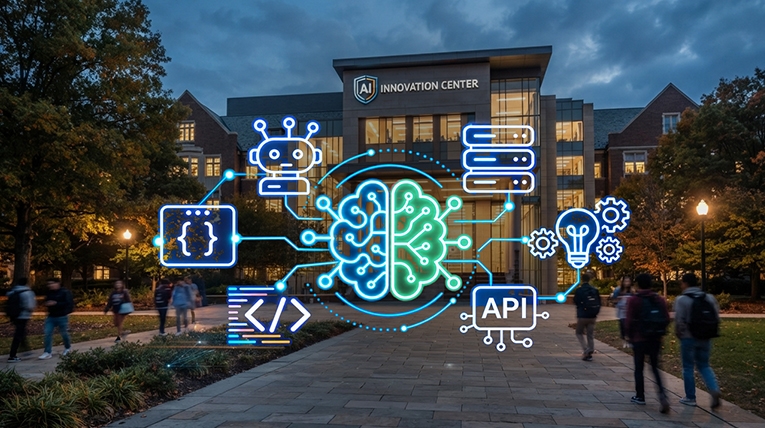
Artificial Intelligence is reshaping how people learn, work, conduct research, and solve problems. As AI adoption accelerates across industries, educational institutions must prepare students not only to understand AI but also to apply it creatively and responsibly.
According to the World Economic Forum’s Future of Jobs Report 2025, 39% of workers’ core skills are expected to change by 2030, with AI and big data among the fastest-growing skill areas. This highlights the growing importance of integrating practical AI and technology skills into education.
To support this transition, VVDN Technologies, in collaboration with Google Cloud, helps educational institutions establish AI Innovation Centres and Centres of Excellence (CoEs), combining technology infrastructure, AI platforms, structured learning, and hands-on innovation.
Table of Contents
Institution-Specific Pathways: From AI Learning to Innovation
Different stages of education require different approaches to AI adoption. VVDN supports schools, colleges and universities through dedicated pathways aligned with their academic requirements and innovation goals.
1. Schools – Building Foundational AI Capabilities
AI Innovation Centres | Set Up. Learn. Build.
Designed to introduce students to AI through age-appropriate learning, educator enablement, and practical activities.
- AI lab infrastructure and learning environments.
- Educator training and structured student learning pathways.
- Hands-on AI projects, workshops, and interdisciplinary activities.
- Responsible AI practices and real-world applications.
2. Universities & Colleges – Advancing Cloud, AI and Applied Innovation
AI Centres of Excellence | Research. Innovate. Incubate. Scale.
Focused on advanced cloud and AI skilling, applied research, solution development, and industry collaboration through initiatives such as:
Digital Campus on Google Cloud (DCGC): Strengthens institutional cloud and AI capabilities through Google Cloud learning resources, hands-on labs, student and faculty skilling, and certification pathways. Depending on the programme tier and applicable terms, institutions can also explore collaborative academic opportunities, including a Joint B.Tech Degree collaboration with Google Cloud.
Agentic AI on Campus: Enables students and faculty to move beyond simply using generative AI tools to understanding, building, and evaluating intelligent AI agents through practical labs and guided projects addressing real-world challenges.
Together, these initiatives help bridge academic learning with industry-relevant skills, research, and innovation.
What VVDN Brings to Institutions
Through its collaboration with Google Cloud, VVDN brings together technology infrastructure, AI platforms, skilling programmes and practical development support to establish these innovation environments.
| Offering | What VVDN Provides |
| AI Infrastructure & Lab Setup | AI workstations, GPU computing, edge AI devices, IoT kits, local servers, and cloud infrastructure. |
| Google Cloud AI Platforms & Tools | Hands-on access to Google AI tools, including Gemini, Gemini Notebook, Google AI Studio, Gemini API, Gemini Enterprise Agent Platform, Agent Development Kit (ADK) and Agent Search. |
| Educator Training & Student Skilling | Train-the-Trainer programmes, curriculum guidance, applied AI learning pathways, hands-on workshops and VVDN + Google Cloud certification opportunities. |
| Project-Based Learning & Prototyping | Guided AI projects, interdisciplinary activities and hackathons across science, commerce, arts, humanities and other disciplines. |
| Applied Research & Agentic AI | University-focused research, industry mentorship, agent development, experimentation, and practical AI use cases. |
| Incubation & Career Enablement | Prototype refinement, solution development, proof-of-concept (PoC) creation and validation, startup incubation support, and guidance from industry experts for promising innovations. |
From Ideas to Working Solutions
The real value of an AI Innovation Centre lies in helping learners translate ideas into practical outcomes. Through guided projects, students learn to identify problems, explore AI approaches, build prototypes, evaluate results and refine their solutions.
Exposure to emerging areas such as generative AI, agentic AI, data, and automation also helps learners understand the capabilities, limitations, and potential applications of these technologies.
Responsible AI in Practice
As students begin working with AI, responsible usage must remain central to the learning process. Institutions should encourage learners to verify AI-generated outputs, recognise potential bias, protect personal information, and remain accountable for their work.
For agent-based applications, this also involves defining permitted actions and ensuring appropriate human oversight, particularly where decisions have significant consequences.
Building the Next Generation of AI Innovators
AI Innovation Centres and Centres of Excellence can help transform institutions into environments where students do more than learn about emerging technologies – they actively experiment, create, and develop solutions.
Through its collaboration with Google Cloud, VVDN Technologies helps schools, colleges and universities build the infrastructure, develop AI capabilities and establish innovation pathways needed to prepare learners for an AI-driven future.
Build Intelligent Ecosystems. Accelerate Innovation. Develop Future-Ready Talent.