
 Global

 United States
 Japan


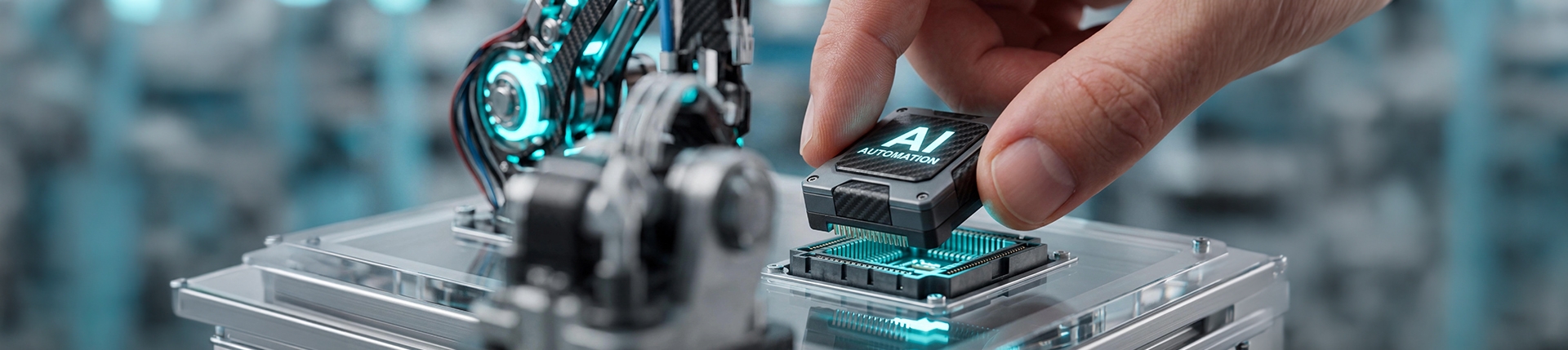
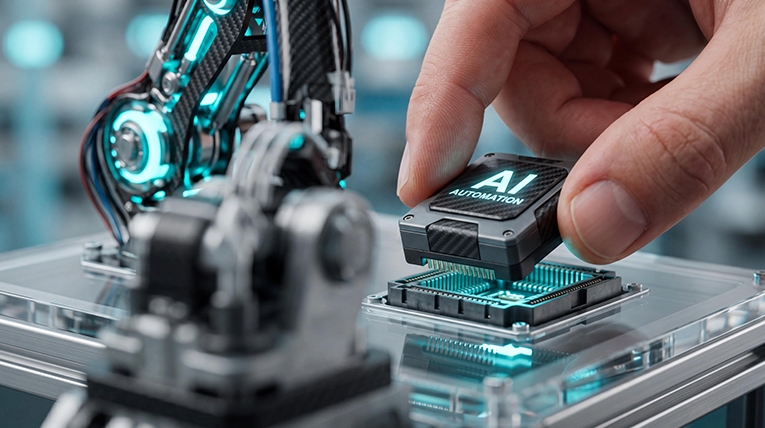
Robotics has moved past the question of whether a robot can perform a task once. Capable hardware is widely available and perception, planning and control increasingly run on learned models, a shift the industry now calls physical AI. The harder question is whether a robot can operate reliably for years across hundreds of sites, with every update, edge case and safety constraint managed throughout its lifecycle.
Teams that solve this are not winning on a single algorithm. They win on the software stack around it: middleware, AI optimization, simulation, compute partitioning and fleet operations, all engineered together. The open building blocks are maturing quickly, shifting the focus towards integration, which is exactly where most robotics programmes stall.
Table of Contents
Technology Overview
A modern robotics software stack is best understood as a set of layers:
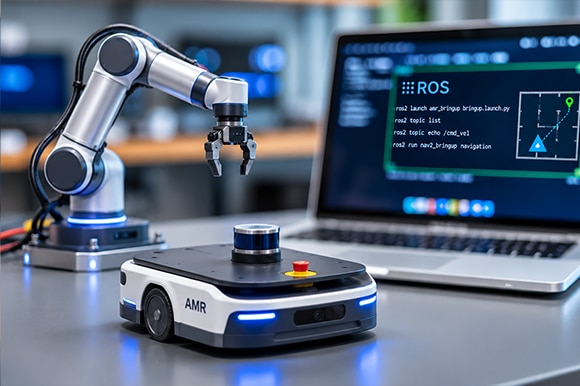
- Middleware and Framework: ROS 2 remains the common backbone, providing teams with a shared communication layer from the lab to deployment.
- Perception and AI: Camera, LiDAR, radar and depth pipelines now sit alongside vision-language-action (VLA) models that use language and visual inputs to perform manipulation tasks.
- Onboard Compute: High-performance AI processors run reasoning models on the robot itself, while programmable logic handles deterministic tasks such as sensor synchronization and motor-control loops.
- Simulation and Digital Twins: Physics-accurate simulation supports scenario testing, synthetic data generation and virtual commissioning before a robot reaches the production floor.
- Fleet, Cloud and OTA (Over the Air) Services: Task orchestration, secure updates, remote diagnostics and telemetry keep deployed robots operational and healthy.
Core Software Functions:
- Perceiving and localizing reliably in cluttered, changing environments.
- Planning and executing motion with predictable timing for mobile robots and manipulators alike.
- Running AI models within the latency, power and thermal limits of an embedded platform.
- Keeping a fleet updated, observable and secure after deployment.
What’s New
The robotics industry is moving rapidly towards Physical AI, where machines can perceive, reason and act in dynamic real-world environments. Advances in robotics middleware are improving communication between software components and enabling more efficient GPU-accelerated processing. At the same time, humanoid robots are progressing from controlled demonstrations towards real-world industrial applications, while simulation-led engineering is helping accelerate development, integration and deployment. As AI models, robotics software and hardware continue to mature, the key challenge is shifting from individual technological breakthroughs to integrating these capabilities into reliable, scalable and production-ready robotic systems. .
Engineering & Manufacturing Challenges
- Latency and Determinism: Perception-to-actuation loops need to be predictable, not just fast. Large neural networks and real-time control systems share the same silicon; how workloads are partitioned determines how consistently a robot performs.
- Compute and Power: AI models, SLAM and planning algorithms must coexist within the same power-constrained platform, subject to stringent thermal constraints. An AI model that performs efficiently on a workstation does not necessarily meet the required power, thermal and frame-rate constraints on an embedded platform.
- Integration: Sensors, actuators, safety controllers and cloud services operate on different cycles. Hardware abstraction enables teams to replace components without requiring changes to the application layer.
Why It Matters
For robot OEMs, system integrators and startups, software maturity is increasingly a key factor in determining time to market. Even the most capable AI model can fall short when the underlying software stack is not engineered for real-world demands, leading to latency issues, excessive power consumption or unreliable performance. For end users across warehouses, factories and logistics operations, success comes down to consistent uptime, operational safety and dependable performance over years of use. As open platforms make robotics more accessible, the real differentiator is no longer just access to AI models, but the engineering discipline required to turn them into reliable, production-ready robots.
Where VVDN Fits In
Developing a robotics solution involves much more than building algorithms. The real challenge lies in bringing together hardware, software, perception and control into a system that performs reliably in real operating environments. This requires the ability to develop, integrate, optimize and validate every part of the robotics stack.
VVDN brings together these engineering capabilities to support robotics development from the initial architecture through deployment. Its areas of expertise include:
- ROS 2 Framework and Middleware: Building modular ROS 2 software architectures that can be adapted to different robotic platforms and applications. This includes lifecycle management, QoS configuration, real-time optimization, system monitoring and diagnostics to support reliable communication between sensors, controllers and other system components.
- Edge AI and Intelligent Perception: Developing and optimizing AI models for deployment on embedded and edge platforms. Techniques such as quantization, pruning, operator fusion and hardware acceleration help improve inference performance. Applications include object detection, image segmentation, 3D perception, pose estimation and sensor fusion.
- Vision-Guided Robotics and Motion Control: Connecting machine vision systems with robotic operations to enable accurate object detection, localization and manipulation. This covers camera and hand-eye calibration, coordinate transformation, vision-based pick-and-place, trajectory planning and collision-aware motion execution.
- Navigation and Autonomous Systems: Developing the capabilities required for robots to navigate their surroundings, including mapping, localization, path planning, obstacle detection and avoidance. These technologies support autonomous mobile robots and other intelligent robotic platforms.
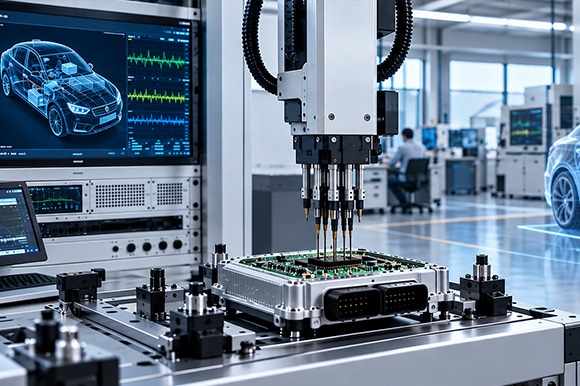
- Simulation, Digital Twins and Validation: Using simulation and digital twin environments to test robotic systems before deploying them on actual hardware. Software-in-the-Loop (SIL), Hardware-in-the-Loop (HIL) and automated regression testing help identify integration problems early, validate system behavior and minimize commissioning efforts.
- Industrial Connectivity and System Integration: Bringing together different hardware components, including industrial cameras, LiDAR, IMUs, encoders, PLCs and robot controllers. Integration with factory systems and industrial communication protocols helps ensure that robotic solutions work effectively within existing manufacturing environments.
- Fleet Management, Cloud and OTA Services: Supporting the operational side of connected robotics through device provisioning, identity management, telemetry, remote monitoring and diagnostics. Secure over-the-air (OTA) updates, along with update validation and rollback capabilities, help maintain deployed systems throughout their lifecycle.
For applications where processing speed and predictable response times are critical, VVDN also works with AMD’s adaptive computing portfolio, including Kria System-on-Modules (SOMs) and Versal AI Edge SoCs. These platforms provide opportunities to offload computationally intensive tasks to programmable logic and, where supported, AI Engines. This can be particularly useful for image pre-processing, sensor fusion and real-time perception, where hardware acceleration can help meet demanding latency and power requirements.
The benefits of hardware acceleration depend on the application and system architecture, but a carefully optimized implementation can improve processing efficiency, reduce latency and support more compact, power-efficient designs.
VVDN works with OEMs, system integrators and robotics startups based on their individual engineering requirements. Customers can engage VVDN for support in specific areas, such as embedded AI or ROS 2 development, or work with VVDN across the complete product development cycle, from architecture and prototyping to integration, deployment and ongoing product support.
By combining expertise in robotics software, embedded engineering, computer vision and hardware acceleration, VVDN aims to help businesses move robotics solutions beyond the development stage and towards reliable, scalable deployment in real-world industrial environments.
Future Outlook
The next stage in robotics software development will focus on operationalizing Physical AI rather than simply demonstrating its capabilities. With humanoid robots entering live production trials, expect greater attention to robot-level reasoning, AI safety assurance, data flows that feed models with information from field deployments and closer integration between simulation and fleet telemetry. As open stacks become more widely adopted, the sustainable competitive advantage will lie in engineering perception, planning, control, computing and cloud capabilities as an integrated system.
For More Information , Contact Us at info@vvdntech.com.