
 Global

 United States
 Japan



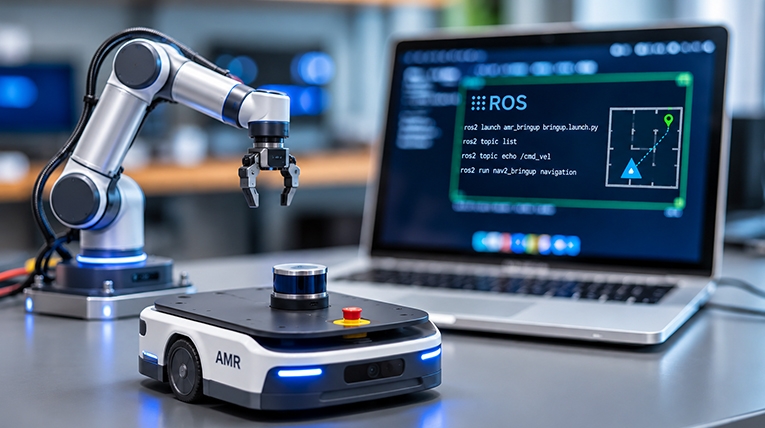
Robotics is moving beyond traditional automation. Today’s Autonomous Mobile Robots (AMRs), industrial manipulators, collaborative robots and humanoid platforms are becoming increasingly intelligent, connected and autonomous.
These systems combine sensors, embedded computing, AI, perception and motion control to understand their surroundings and respond to changing environments. This evolution is also driving the growth of Physical AI, where artificial intelligence moves beyond digital applications to interact with and operate in the physical world.
Building such intelligent robotic systems requires a flexible software architecture that allows different hardware and software components to communicate seamlessly. This is where the Robot Operating System 2 (ROS 2) plays an important role.
ROS 2 provides a modular framework for developing distributed robotic applications, helping engineers integrate sensors, actuators, navigation, perception and AI capabilities into scalable robotic platforms.
Table of Contents
What Is ROS 2 and Why Does It Matter?
ROS 2 is an open-source robotics middleware and software framework designed to simplify the development of robotic applications. It provides communication mechanisms, reusable libraries, hardware interfaces and development tools that enable different software components to work together.
Unlike a traditional operating system, ROS 2 does not replace Linux or directly control every hardware component. Instead, it acts as a communication and integration layer between robotic applications, sensors, actuators and computing platforms.
Its modular architecture allows developers to build independent software components, making robotic systems easier to develop, test, upgrade and maintain.
Some key advantages include:
- Modular Architecture: Develop and integrate independent software components.
- Distributed Communication: Enable communication across multiple processors and computing systems.
- Hardware Integration: Connect sensors, actuators and embedded platforms through standardised interfaces.
- Flexible Communication: Configure Quality of Service (QoS) settings according to application requirements.
- Scalability: Support applications ranging from individual robots to distributed robotic systems.
These capabilities make ROS 2 a strong foundation for modern industrial and autonomous robotics.
Understanding the ROS 2 Architecture
ROS 2 follows a distributed architecture in which individual software components communicate through a middleware layer. Each component performs a specific function, allowing developers to build complex robotic applications without tightly coupling the entire system.
The architecture primarily consists of nodes, communication interfaces, middleware and hardware integration components.
Nodes are independent software processes responsible for specific functions. In an AMR, for example, separate nodes can handle camera acquisition, LiDAR processing, object detection, localisation, navigation and motor control.
These nodes communicate through three primary mechanisms:
- Topics: Enable continuous data exchange using a publish-subscribe model. Common examples include camera images, LiDAR scans and robot odometry.
- Services: Support request-and-response communication for operations such as sensor configuration, calibration and system resets.
- Actions: Manage long-running tasks such as navigating to a destination or executing a robotic manipulation sequence, with progress feedback and cancellation support.
ROS 2 commonly uses Data Distribution Service (DDS) through its ROS Middleware Interface (RMW) for communication between distributed components. It also provides Quality of Service (QoS) settings to configure message reliability, durability and delivery behaviour based on application requirements.
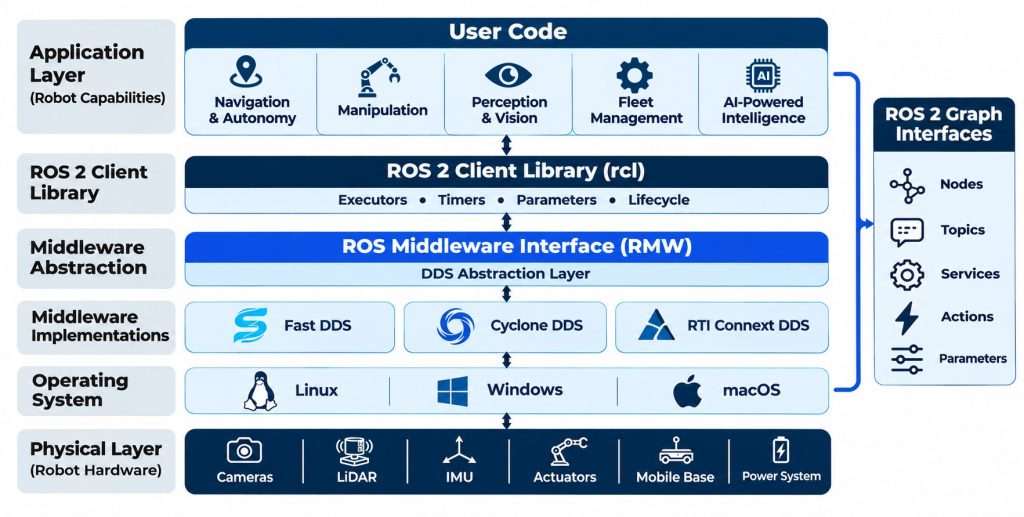
Figure 1: ROS 2 architecture illustrating application capabilities, middleware communication, hardware abstraction, and physical robot components.
ROS vs. ROS 2 vs. RTOS: Understanding the Difference
Although these technologies are used in robotics development, they serve different purposes.
ROS (Robot Operating System) was originally designed to provide a flexible framework for robotic software development, primarily using a centralised discovery mechanism through the ROS Master. ROS 2 is its next-generation evolution, introducing a distributed architecture, DDS-based communication, configurable QoS, improved security capabilities and better support for real-time system integration.
An RTOS (Real-Time Operating System), on the other hand, is designed to execute critical tasks within predictable timing constraints. It is commonly used for time-sensitive operations such as motor control, actuator management and safety-related functions.
In modern robotics, ROS 2 can operate alongside an RTOS, with ROS 2 managing higher-level intelligence and coordination while real-time components handle deterministic control.
ROS 2 and Physical AI: Bringing Intelligence into the Physical World
The emergence of Physical AI is transforming how robots perceive, understand and interact with their environments.
Unlike conventional automation, which relies heavily on predefined instructions, Physical AI combines AI models, sensor data, perception and decision-making to enable more adaptive robotic behaviour.
ROS 2 provides the software integration layer required to connect these capabilities with physical robotic systems.
A typical Physical AI workflow involves:
Sensors → Data Processing → AI Inference → Decision Making → Motion Planning → Robot Control
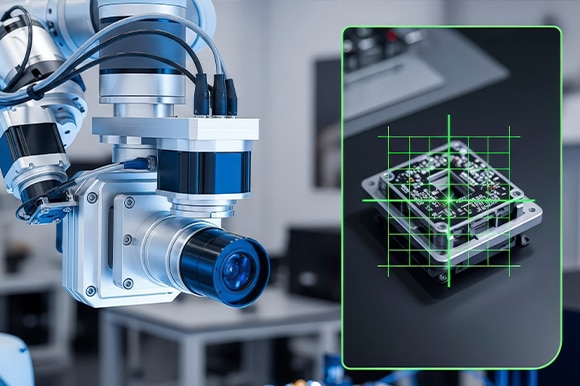
For example, a vision-guided robotic arm can capture images, identify objects using AI models, estimate their positions and execute precise manipulation tasks.
Similarly, an AMR can use cameras and LiDAR to recognise obstacles, identify surrounding objects, estimate its location and dynamically adjust its navigation.
These applications require seamless integration between AI algorithms, embedded computing platforms, sensor interfaces and motion control systems.
Edge Computing: Enabling Intelligent Robotics
AI-powered robotic applications generate significant amounts of data through cameras, LiDAR, depth sensors and other peripherals. Processing all this information through cloud infrastructure can introduce latency, increase bandwidth requirements and create network dependencies.
Edge computing addresses these challenges by bringing processing and AI inference closer to the robot.
A typical robotics edge computing platform combines:
- CPU-based processing for ROS 2 nodes, navigation and application logic.
- GPU or NPU acceleration for AI inference and computer vision.
- Sensor interfaces for cameras, LiDAR, IMUs and encoders.
- Connectivity through Ethernet, Wi-Fi, or cellular networks.
- Local storage for operational data, maps and AI models.
Embedded robotics platforms such as NVIDIA® Jetson, Qualcomm, NXP, AMD Ryzen™ AI and other suitable computing solutions can support these workloads, depending on processing, power, thermal and interface requirements.
By combining ROS 2 with edge AI, robotic systems can process sensor information locally, improve responsiveness and operate with reduced dependence on continuous cloud connectivity.
ROS 2 in Autonomous Mobile Robots and Industrial Automation
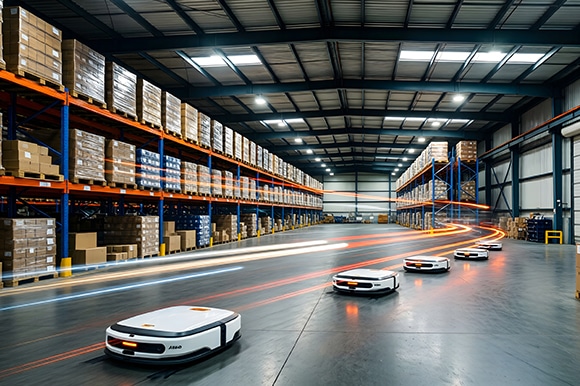
Autonomous Mobile Robots are a practical example of ROS 2 in action. These robots combine multiple subsystems to navigate dynamic environments and perform tasks with minimal human intervention.
A ROS 2-based AMR typically integrates:
- Perception: Camera- and LiDAR-based object and obstacle detection.
- Localisation and Mapping: Estimating robot position and generating environmental maps.
- Navigation: Planning routes and adapting to obstacles.
- Motion Control: Managing wheel movements, motors and actuators.
- Fleet Management: Coordinating tasks and monitoring multiple robots.
Frameworks such as Nav2 provide reusable navigation capabilities, while SLAM and localisation packages support mapping and positioning.
In industrial environments, similar ROS 2 capabilities can support robotic arms, machine vision systems, automated material handling and collaborative robotic applications.
The modular architecture also makes it easier to upgrade sensors, integrate new AI models and adapt robotic platforms to different operational requirements.
From Simulation to Real-World Deployment
Developing a production-ready robotic system requires extensive testing and validation. Simulation helps engineering teams evaluate robotic behaviour before deploying software on physical hardware.
ROS 2 can integrate with simulation environments such as Gazebo to test navigation, perception, sensor behaviour, and motion planning.
Tools such as RViz help visualise robot positions, sensor data, maps, and coordinate frames.
However, simulation alone cannot account for every real-world condition. Sensor noise, mechanical variations, communication delays and environmental changes must also be evaluated through hardware-in-the-loop testing and physical validation.
A combination of simulation, software testing, hardware integration and real-world trials helps improve system reliability before deployment.
Engineering Scalable Robotics Solutions with VVDN
Building intelligent robotic products requires expertise across embedded hardware, software development, AI, perception, system integration and manufacturing.
VVDN Technologies provides end-to-end product engineering and manufacturing services to support OEMs in developing next-generation robotics solutions.
VVDN’s robotics engineering capabilities include:
- Robotics System Engineering: System architecture, compute platform selection, sensor integration and subsystem development.
- Embedded Software Development: BSP, device drivers, middleware integration and application software.
- ROS 2 Integration: Integrating ROS 2-based applications with embedded computing platforms, sensors and control interfaces.
- Edge AI and Machine Vision: AI inference, camera integration, perception pipelines and hardware acceleration.
- Robotics Hardware Engineering: Processor-based designs, peripheral integration, power management and thermal engineering.
- Prototyping and Manufacturing: Hardware-software integration, validation and production industrialisation.
VVDN is also developing an in-house Autonomous Mobile Robot (AMR) reference design based on NVIDIA® Jetson Xavier™ NX / Orin NX and has developed an NXP i.MX94 System-on-Module (SoM) for robotic controller applications.
By combining embedded engineering, AI integration, robotics development and manufacturing capabilities, VVDN helps OEMs accelerate the development of scalable and intelligent robotic products.
Conclusion
ROS 2 is playing an important role in the evolution of modern robotics by providing a flexible foundation for distributed communication, hardware integration and intelligent robotic applications.
When combined with edge computing, AI-powered perception and real-time control architectures, it enables the development of autonomous, adaptable and connected robotic systems.
As Physical AI continues to evolve, the integration of software, embedded hardware and intelligent computing will become increasingly important in bringing next-generation robots from prototypes to commercial deployment.
VVDN Technologies supports OEMs in this journey through end-to-end robotics engineering and manufacturing capabilities, helping build the next generation of intelligent robotic systems.
To learn more about VVDN’s Robotics engineering capabilities, click here.