
 Global
 United States
  Japan
Japan 



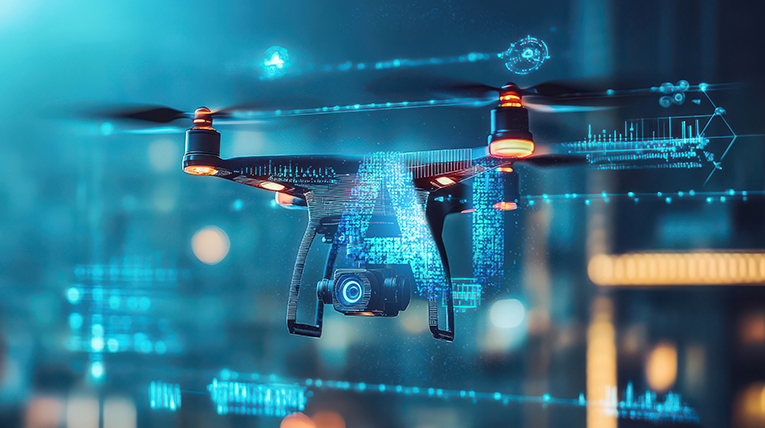
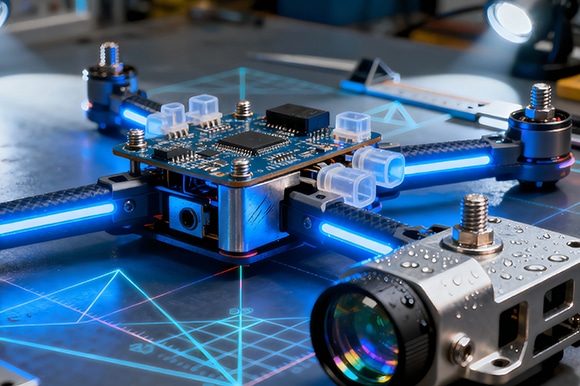
Drones are no longer just remotely operated flying devices—they are rapidly evolving into intelligent, autonomous systems capable of making real-time decisions. At the heart of this transformation lies Artificial Intelligence (AI) at the edge, enabling drones to process data locally, respond instantly and operate with minimal human intervention.
In this blog, we explore how AI is reshaping drone capabilities and why edge intelligence is becoming critical for next-generation drone applications.
Table of Contents
The Shift from Remote Control to Autonomous Intelligence
Traditional drones relied heavily on ground control systems for navigation, data processing and decision-making. However, this approach comes with inherent limitations:
- High latency in communication
- Dependency on network connectivity
- Limited real-time responsiveness
With AI integrated directly into onboard systems, drones can now:
- Analyze data in real time
- Make autonomous decisions
- Adapt to dynamic environments
This shift is enabling true autonomy, especially in mission-critical applications.
Key AI Capabilities in Modern Drones
1. Computer Vision & Object Detection
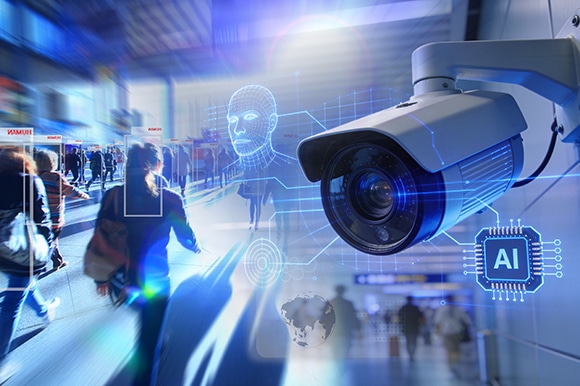
AI-powered vision systems allow drones to:
- Detect and track objects (vehicles, people, assets)
- Perform facial or license plate recognition
- Enable perimeter security and surveillance
This is especially critical for security, smart cities and industrial monitoring.
2. Obstacle Detection & Avoidance
Using a combination of sensors and AI algorithms, drones can:
- Identify obstacles in real time
- Calculate optimal flight paths
- Avoid collisions autonomously
This capability is essential for operating in complex or GPS-denied environments.
3. Autonomous Navigation & Path Planning
AI enables drones to:
- Execute pre-defined missions intelligently
- Dynamically adjust routes based on real-time inputs
- Operate beyond visual line of sight (BVLOS)
4. Edge-Based Data Processing
Instead of sending raw data to the cloud, drones process information onboard:
- Reduced latency
- Lower bandwidth usage
- Improved data security
This is particularly important in defense, industrial inspection and remote operations.
Why Edge AI is Critical for Drones
Cloud-based processing alone cannot meet the demands of real-time drone operations. Edge AI bridges this gap by bringing compute closer to the source.
Key benefits include:
- Ultra-low latency decision-making
- Enhanced data privacy and security
- Reduced dependence on connectivity
- Optimized power and bandwidth usage
Edge AI ensures drones can operate reliably even in low-connectivity or mission-critical environments.
Enabling Hardware: The Backbone of AI Drones
AI capabilities in drones are powered by advanced embedded hardware platforms that combine:
- High-performance CPUs, GPUs, and NPUs
- Dedicated AI accelerators
- Efficient power management systems
- High-speed sensor interfaces
Modern platforms from leading silicon providers enable real-time AI inference on-device, making autonomous drones a reality.
Real-World Applications of AI-Enabled Drones
AI-driven drones are transforming multiple industries:
- Industrial Inspection: Automated monitoring of pipelines, power lines and infrastructure
- Smart Cities: Traffic monitoring, crowd analysis and surveillance
- Agriculture: Crop health monitoring and precision farming
- Disaster Response: Search and rescue, damage assessment
- Defense & Security: Intelligent reconnaissance and threat detection
How VVDN Enables AI-Powered Drone Solutions
At VVDN Technologies, we bring deep expertise in designing and deploying AI-enabled drone and vision systems, supporting OEMs from concept to mass production.
Our capabilities include:
- End-to-End Product Engineering
Hardware design, embedded software, mechanical design and system integration - Edge AI Platform Development
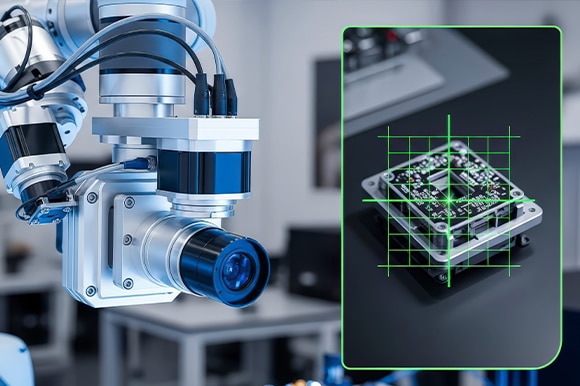
Experience with leading silicon platforms, enabling real-time AI processing at the edge - Camera & Vision System Expertise
Design and development of high-performance camera modules for aerial applications - Connectivity Integration
RF, Wi-Fi and cellular (including 5G) integration for seamless drone communication - Manufacturing at Scale
Proven capabilities in high-volume, quality-driven production
With production-ready building blocks and strong ecosystem partnerships, VVDN helps accelerate the development of next-generation autonomous drone platforms.
Conclusion
AI at the edge is fundamentally transforming drones from simple flying devices into intelligent, autonomous systems capable of real-time decision-making.
As industries increasingly adopt drones for critical operations, the demand for robust, scalable and intelligent drone platforms will continue to grow—and edge AI will be at the core of this evolution.