






 Global
  United States
 Japan
Japan 





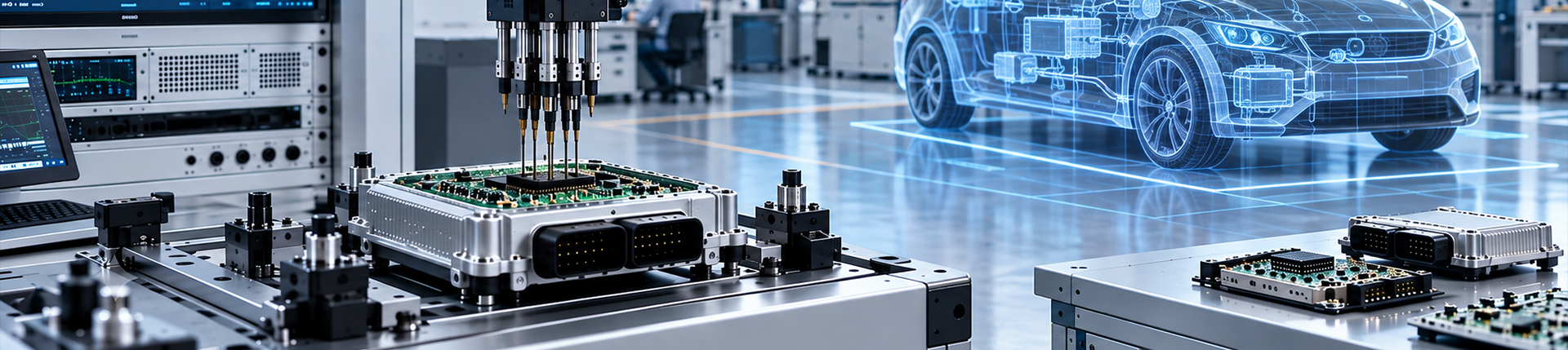
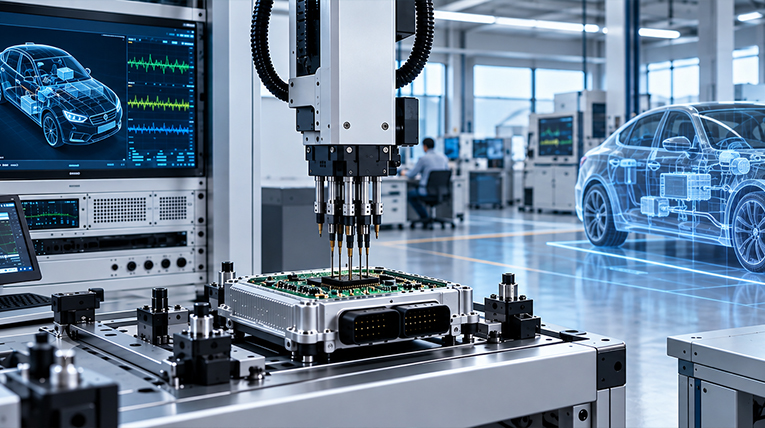
Electronics are the backbone of today’s modern vehicles, powering everything from connectivity and ADAS to EV battery and vehicle control systems. As vehicle architectures become more complex, manually testing every function becomes slower, more expensive, and increasingly difficult to reproduce consistently.
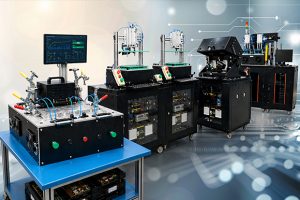
This is where Automotive Automated Test Equipment (ATE) becomes essential. Automotive ATE combines measurement hardware, signal generation, switching, simulation, control software, and test automation to validate electronic systems consistently across development, validation, and production.
Table of Contents
Why Automated Testing Is Becoming Essential for Modern Vehicle Electronics
The challenge is no longer simply verifying whether an electronic component works. Engineers need to determine how a system behaves across different operating conditions, fault states, temperature ranges, communication conditions, and software versions.
For safety-critical automotive electronics, structured verification and testing are also essential. ISO 26262 addresses safety-related electrical and electronic systems and includes requirements for verification and testing of embedded software.
Manual testing cannot efficiently reproduce a large number of scenarios with consistent timing and measurement conditions. Automated systems can execute predefined test sequences, capture measurements, compare results against expected limits, generate reports, and repeat tests following hardware or software changes.
As vehicles become increasingly electrified, connected and software-defined, automated testing is therefore becoming an important part of both product development and manufacturing.
Automotive Electronics Testing Applications
As automotive electronics become more complex, manufacturers need automated test systems that can validate everything from individual PCB assemblies to complete electronic modules.
VVDN designs and manufactures custom ATE solutions that combine electrical testing, functional validation, communication testing, diagnostics, simulation, and production verification based on the product under test.
1. ECU Testing and Validation
Electronic Control Units (ECUs) are at the heart of modern vehicles, controlling functions across the complete vehicle electronics (powertrain, braking, steering, transmission, body electronics, thermal management, and lighting)
Automated ECU testers can simulate inputs, monitor outputs, communicate with the ECU, execute diagnostic routines, inject faults, and verify responses against defined requirements. These systems can be used during product validation as well as production testing, providing repeatable and automated test execution.
2. ADAS and Camera Electronics Testing
ADAS depends on increasingly sophisticated camera modules, sensor electronics, and processing hardware. Ensuring these systems perform consistently is critical for applications such as lane keeping, automatic emergency braking, parking assistance, and driver monitoring.
Automated test equipment can support multiple stages of the camera manufacturing and validation process. Camera PCBA Functional Testers can verify electronic assemblies, Camera Tuning Stations can support image and camera parameter optimisation, and Camera EOL Testers can validate finished modules against defined production requirements.
3. Battery Management System Testing
The BMS is a critical electronic system in electric vehicles, responsible for monitoring and managing battery cells, temperatures, balancing, and protection functions.
Automated BMS testers can reproduce different battery operating conditions and sensor inputs in a controlled environment. VVDN’s BMS testing solutions can support multi-channel cell simulation with ±5 mV accuracy and multi-channel NTC emulation with ±1°C accuracy, along with cell balancing validation, pre-charge and pre-discharge testing, load simulation, and programmable fault injection.
For high-current applications, infrared thermal profiling can also be used to monitor FET temperatures and identify potential thermal anomalies.
4. EV Charger Testing
As EV charging infrastructure expands, manufacturers need reliable ways to validate charger electronics throughout development and production.
Automated test systems can be designed for different stages of EV charger manufacturing. EV Charger PCBA Functional Testers verify the electronic assembly, while EOL Testers validate the completed charger against production requirements. Ageing Testers can further evaluate charger performance under defined operating conditions over extended periods.
5. High Voltage and Electrical Safety Testing
High voltage electronics introduce specific safety and reliability requirements that need to be verified during manufacturing.
Automated HIPOT testing can apply controlled high voltage to assess insulation and electrical withstand capability. Combined with other electrical and functional tests, HIPOT can become part of an automated production test sequence, helping manufacturers consistently identify insulation and isolation failures.
6. Automotive Connectivity and RF Testing
Modern vehicles increasingly depend on wireless technologies such as Wi-Fi, Bluetooth, GNSS, V2X, and cellular connectivity.
Automated testing can validate RF performance, connectivity, signal integrity, and functional behaviour under controlled conditions. A PCBA Tester can verify connectivity-related functions at the board level, while RF Calibration and EOL Test Stations can validate RF performance and the completed module before vehicle integration.
7. IVI and Cockpit Electronics Testing
Modern IVI and cockpit systems combine displays, audio, navigation, connectivity, touch interfaces, and communication with other vehicle systems.
Automated testing can verify functional behaviour, interfaces, communication, diagnostics, and defined system parameters. IVI EOL Testers can also be integrated into production lines to verify finished units before they are shipped for vehicle integration.
8. Automotive Communication and Diagnostics Testing
Modern vehicle electronics rely on communication between ECUs, sensors, actuators, gateways, and centralised computing platforms.
ATE can automate communication and diagnostic testing across protocols such as CAN, CAN FD, LIN, FlexRay, and Automotive Ethernet. Test systems can verify message transmission, signal values, timing, diagnostic responses, error handling, and recovery behaviour.
This becomes increasingly important as vehicles move towards centralised and zonal architectures, where a communication issue can impact multiple vehicle functions.
9. End-of-Line Testing for Automotive Electronics
EOL testing is where automated test equipment becomes an important part of the production process. The objective is simple: verify that every finished electronic product meets its defined functional, electrical, and quality requirements before it leaves the manufacturing line.
Depending on the product, an EOL tester can perform electrical measurements, ECU communication, sensor and actuator checks, diagnostics, RF validation, functional tests, and programmed parameter verification.
VVDN’s automotive ATE capabilities span BMS, ADAS and camera electronics, EV chargers, IVI, ECUs, and other automotive electronic products, enabling manufacturers to automate testing from PCBA validation through final production verification.
Emerging Trends Shaping the Future of Automotive ATE
Automotive test systems are evolving alongside the vehicle itself. Software-defined vehicles, centralised computing, zonal architectures, electrification, and connected systems are expanding the scope of system-level validation.
Another important direction is the convergence of simulation, automation, and data analytics. Digital twins, automated test generation, predictive analytics, and AI-assisted analysis can help engineers create larger test scenarios, identify patterns in test results, and focus attention on potential failures.
The future is therefore moving towards a connected validation ecosystem in which requirements generate test cases, simulation creates scalable scenarios, ATE executes measurements, analytics evaluates the results, and automated workflows feed findings back into hardware and software development.
As automotive electronics continue to evolve, ATE will increasingly need to support not only individual components but also the interaction between hardware, software, connectivity, and complete vehicle systems.
Why Choose VVDN for Automotive ATE
VVDN develops application-specific automated test solutions for automotive electronics, helping manufacturers improve test coverage, validation efficiency, and production quality.
Our solutions support applications including BMS, cameras, EV chargers, and IVI systems, with testing capabilities spanning functional, validation, reliability, electrical safety, and end-of-line testing.
Whether you are developing a new automotive electronic system or improving an existing test process, VVDN can help build an ATE solution tailored to your application and testing requirements.
Looking to improve your automotive testing? Get in touch with our experts.