






 Global
  United States
 Japan
Japan 






In today’s electronics manufacturing world, the difference between a line that scales smoothly and one that keeps running into issues often comes down to a simple question:
How well is testing built into your process?
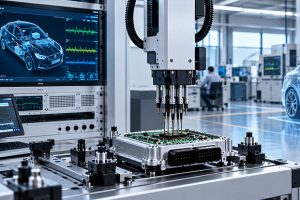
There was a time when Automated Test Equipment (ATE) sat at the very end of the line, acting as a basic pass or fail checkpoint. That approach doesn’t hold up anymore. Now, ATE is woven into the entire production cycle. It works as a real-time validation layer, a source of valuable data insights, and a key driver of yield, throughput, and overall cost efficiency.
For engineering and manufacturing teams operating at high volumes, this shift isn’t just good to have. It’s essential to stay competitive.
Table of Contents
From End-of-Line Gate to Embedded Intelligence
Traditional ATE was reactive by design: test after manufacturing, catch defects late, rework or scrap. The cost of that approach, in time, materials, and throughput, compounds at scale.
Modern ATE flips that model. Systems are now deployed at multiple stages of the production lifecycle, enabling:
- Real-time validation during assembly, not just after
- Early-stage defect detection that reduces downstream rework
- Closed-loop feedback into design and process optimization
The shift eliminates the inefficiencies inherent to manual testing, operator variability, inconsistent coverage, and slower cycle times and replaces them with deterministic, repeatable processes that can be audited and continuously improved.
How ATE Directly Drives Manufacturing Performance
Yield Improvement Through Upstream Insight
Catching defects at ICT or functional test stages, rather than end-of-line or in the field, dramatically reduces the cost per defect. ATE systems that monitor parametric trends across production batches enable process engineers to act on data, not assumptions.
Faster Validation Cycles, Faster Launches
High-throughput ATE reduces test cycle time without sacrificing measurement accuracy. For product teams under tight launch timelines, this translates directly to compressed validation schedules and faster time to revenue.
Cost Efficiency at Production Scale
Automated testing reduces dependency on skilled operators for routine validation tasks, lowers rework rates, and improves OEE (Overall Equipment Effectiveness). At volume, these gains compound significantly.
Standardized Scalability
ATE enforces repeatable test coverage across shifts, lines, and facilities. This consistency is what makes scaling production, whether adding capacity or replicating lines, operationally feasible without quality regression.
ATE as the Data Engine of Smart Factories
The most underutilized capability of modern ATE is the data it generates.
Every test cycle produces structured measurements across functional, electrical, and performance parameters. When this data is integrated with MES platforms and analytics pipelines, it enables:
- Predictive maintenance, identifying equipment drift before it causes yield loss
- Root cause analysis, correlating test failures with upstream process variables
- Continuous process improvement, feeding production data back into engineering
In a smart factory architecture, ATE isn’t a passive instrument, it’s an active participant in real-time decision-making.
This evolution also aligns with the rise of Physical AI in manufacturing, where intelligent systems do not just analyze data but act on it in real time. By feeding high-quality, structured test data into AI models, ATE enables systems to detect anomalies, adjust process parameters, and optimize production dynamically.
In this context, ATE becomes a foundational layer for Physical AI, bridging the gap between digital intelligence and physical manufacturing execution.
What Makes Up a Modern ATE System?
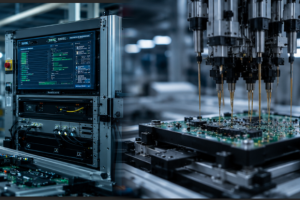
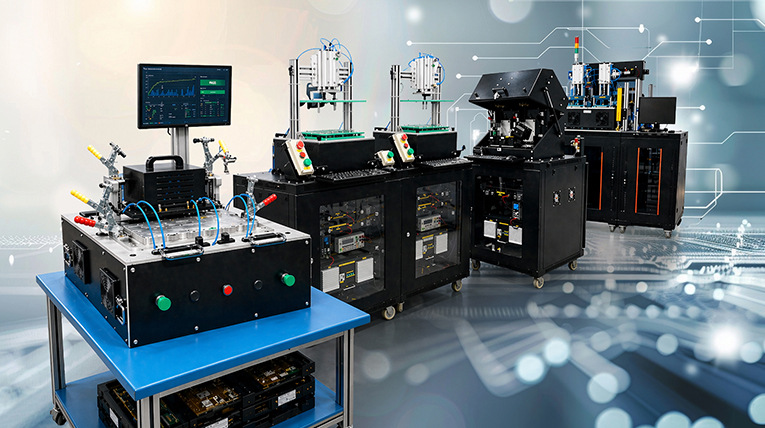
For engineers evaluating or designing ATE infrastructure, the key components include:
- Test fixtures and probes, precision DUT interface for repeatable electrical contact
- Instrumentation, oscilloscopes, multimeters, signal generators, power supplies for accurate measurement
- Control hardware, industrial PCs or microcontrollers executing test sequences
- Test software, automation frameworks handling sequencing, data logging, and reporting
- Safety and monitoring systems, ensuring traceability, operator safety, and regulatory compliance
The integration of these layers, and how well they interoperate, determines the system’s throughput, flexibility, and total cost of ownership.
Key Testing Domains ATE Supports
Modern ATE systems handle a broad range of validation requirements:
- Functional Testing, end-to-end performance validation under real operating conditions
- In-Circuit Testing (ICT), PCB-level fault detection for opens, shorts, and component values
- RF and Wireless Testing, protocol and RF performance validation for connectivity products
- Optical and Camera Testing, imaging performance across resolution, distortion, and color accuracy
- Power and Battery Testing, electrical characterization and safety validation
- Audio and Video Testing, signal integrity and output quality assessment
- Burn-in Testing, accelerated stress testing for early-life failure detection
- End-of-Line Testing, final product conformance check before shipment
ATE in the Connected Production Ecosystem
ATE no longer operates as a standalone system. In integrated manufacturing environments, it works in real time alongside:
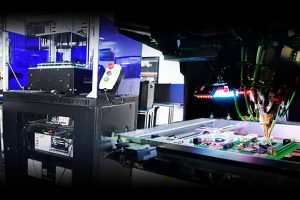
- Robotic assembly systems for automated DUT handling and loading
- Machine vision systems for pre-test inspection and alignment
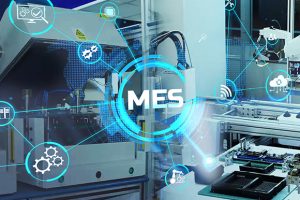
- MES platforms for workflow orchestration, traceability, and reporting
This interconnectedness is what enables true closed-loop manufacturing, where test data directly informs upstream processes and operational decisions happen in real time, not after shift reviews.
Real-World Impact: From Manual to High-Throughput
The transition from manual testing to automated ATE in high-volume electronics manufacturing consistently delivers measurable results:
- Higher production throughput with reduced operator bottlenecks
- Improved first-pass yield through consistent test coverage
- Greater test accuracy and repeatability across shifts
- Scalable production lines that don’t require proportional headcount growth
These aren’t incremental improvements; they’re structural advantages that compound over production lifecycles.
Why VVDN for ATE?
VVDN doesn’t offer off-the-shelf test solutions. We engineer ATE systems built around your specific product architecture, production environment, and scalability requirements.
Our end-to-end ATE capabilities include:
- Design for Test (DFT) Analysis, testability review at the design stage to ensure ATE compatibility before hardware is built
- Custom Fixture and Jig Development, precision mechanical design for reliable, repeatable DUT interface
- Electrical and Instrumentation Design, custom signal conditioning, switching, and measurement architecture
- Automated Test Software Development, scalable test sequencers with data logging, reporting, and MES integration
- End-to-End Deployment and Support, from lab validation through full production rollout
VVDN’s ATE solutions are production-proven across automotive, telecom, consumer electronics, and industrial systems environments where test accuracy, throughput, and traceability are non-negotiable.
If you’re evaluating ATE for a new product line, scaling an existing production system, or replacing manual testing with automated infrastructure, VVDN has the engineering depth to execute, from DFT review through high-volume deployment.
Explore VVDN’s ATE capabilities
For more information, click here or reach out to us at info@vvdntech.com.