




 Global
  United States
 Japan
Japan 






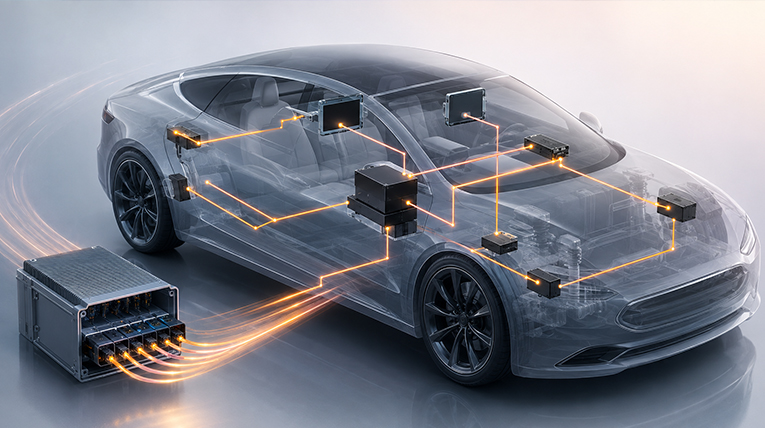
The modern vehicle is evolving from a collection of electronic control units (ECUs) into a distributed computing platform on wheels. Cameras continuously capture the road, radar sensors track surrounding objects, high-performance computers process large volumes of data, and displays render increasingly complex information. As vehicles become more software-defined, these functions need to communicate simultaneously, reliably, and with precise timing.
This raises a critical question: How does all this data move through the vehicle?
The answer is increasingly Automotive Ethernet. But bandwidth alone is not enough. Safety- and time-sensitive workloads also require predictable communication. A camera frame, radar measurement, or control message cannot simply compete with infotainment traffic or a software download for network resources.
This is where Time-Sensitive Networking (TSN) becomes important. Together, Automotive Ethernet and TSN are emerging as the high-speed, deterministic communication fabric connecting sensors, compute platforms, controllers, and software functions in next-generation vehicles.
Table of Contents
From CAN to Ethernet
CAN has been a foundational automotive networking technology for decades, and it remains valuable because of its robustness, mature ecosystem, and suitability for control-oriented communication. CAN-FD has further extended its capabilities with larger payloads and higher data rates.
However, vehicle data is changing. Modern ADAS systems may include multiple cameras, radar sensors, and other perception systems continuously generating data. At the same time, centralized high-performance computers (HPCs) process AI workloads, displays receive high-resolution graphics, and vehicle systems exchange diagnostics, telemetry, and software updates.
The challenge is no longer limited to communicating small control messages between ECUs. Vehicles increasingly need to transport large, continuous, and diverse data streams across multiple computing nodes. Automotive Ethernet provides a more scalable approach, allowing multiple systems to communicate over a common switched network.
Ethernet as the Vehicle Communication Fabric
Technologies such as 100BASE-T1, 1000BASE-T1, and multi-gigabit Automotive Ethernet variants bring Ethernet into the vehicle while addressing automotive requirements such as weight, electromagnetic compatibility, cabling, and environmental conditions.
Ethernet also enables IP-based communication across vehicle systems. Technologies such as SOME/IP support service-oriented communication, while Diagnostics over IP enables diagnostic functions to leverage Ethernet infrastructure.
However, one important distinction remains:
Fast does not necessarily mean predictable.
Why Deterministic Communication Matters
Consider an Ethernet network carrying a high-resolution camera stream, OTA update, infotainment traffic, and a safety-critical control message simultaneously. If all traffic is treated equally, congestion can introduce variable delays. While this may have little impact on entertainment content, it can be critical for ADAS or vehicle-control functions.
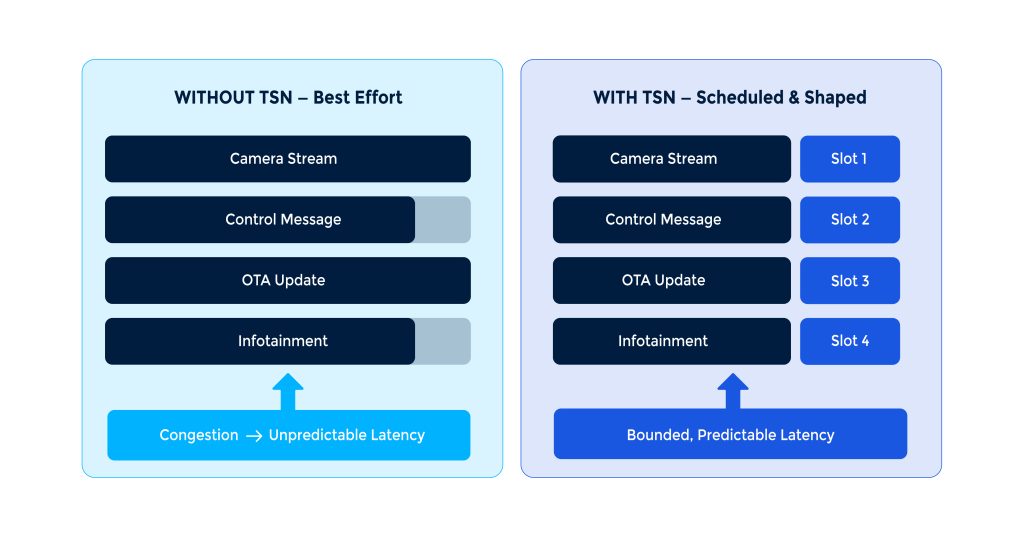
Best-Effort Traffic vs. TSN-Managed Traffic
This is the difference between low latency and deterministic latency.
Low latency means data generally arrives quickly. Deterministic communication means the system can establish predictable timing and bounded delays. This becomes increasingly important as sensors, compute platforms, and controllers participate in distributed processing pipelines.
A camera captures information, the network transports it, an HPC processes it, and another system may use the result to make a decision. The timing of every stage contributes to overall system behavior. The network therefore becomes part of the real-time system.
TSN Makes Ethernet Time-Aware
TSN is not a replacement for Ethernet. It provides mechanisms that make Ethernet more suitable for applications requiring synchronization, predictable delivery, and controlled latency.
Precise time synchronization is particularly valuable for sensor fusion. A vehicle combining camera and radar information needs to know not only what each sensor sees, but also when that information was captured. Significant timing differences between sensor datasets can affect the accuracy of the combined perception result.
TSN also enables traffic scheduling and shaping. Different traffic types can be managed according to their requirements, allowing time-sensitive flows to receive predictable transmission opportunities while less critical traffic uses the remaining network capacity.
The result is not simply a faster Ethernet network, but a time-aware communication infrastructure.
Enabling Zonal Vehicle Architectures
The transition toward zonal architectures makes Automotive Ethernet and TSN even more important.
Traditional vehicle architectures often distribute functionality across a large number of ECUs. Zonal architectures instead organize electronics around physical areas of the vehicle. Sensors and actuators within a zone can connect to a zonal controller, which communicates with centralized computing platforms through a high-speed Ethernet backbone.
A simplified architecture is:
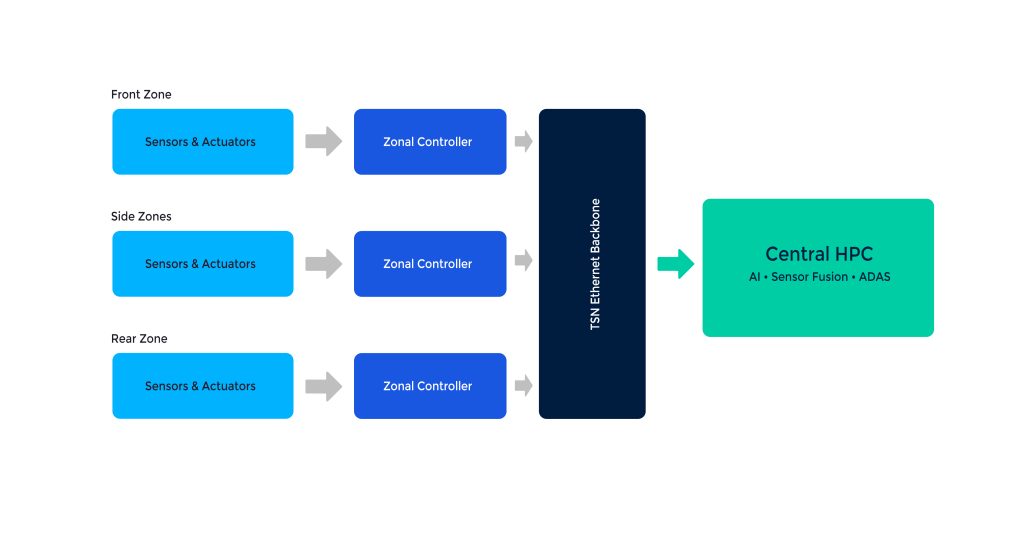
Sensors and actuators in each zone connect through a zonal controller to a shared, TSN-managed Ethernet backbone
This approach can simplify wiring, consolidate computing resources, and create a more scalable electrical/electronic architecture. However, it also increases the importance of the network. When multiple vehicle functions share the same Ethernet backbone, the network must manage bandwidth, latency, synchronization, reliability, redundancy, and security.
The backbone is no longer simply a communication link between ECUs.
It becomes infrastructure.
Centralized HPC and ADAS Drive the Data Challenge
The move toward centralized HPC is a major driver for high-speed automotive networking. Instead of placing significant processing capability next to every sensor or function, manufacturers can consolidate computing resources into platforms containing high-performance CPUs, GPUs, and AI accelerators.
This enables compute resources to be shared more efficiently, but centralization also creates a dependency on the network. An HPC needs access to data from across the vehicle.
For example, a front-facing camera may send data through a zonal controller and Ethernet switch before reaching the central HPC. Radar and other sensors may follow similar paths. The HPC processes this information through AI and sensor-fusion algorithms before sending results to other vehicle systems.
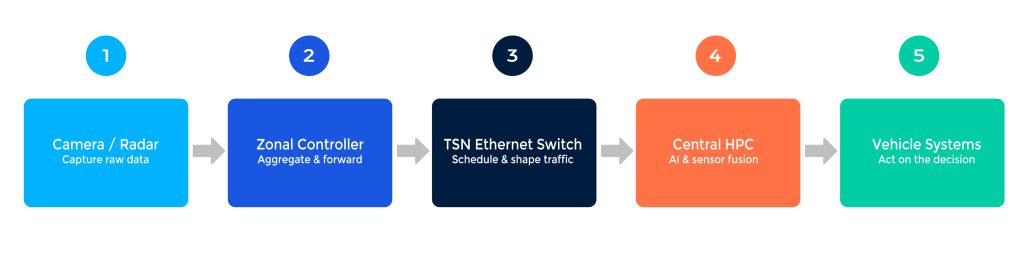
Precise time synchronization lets the HPC align data captured by different sensors at different moments.
ADAS provides a clear example of this requirement. Cameras provide rich visual information, radar provides object and distance information, and other sensors contribute additional environmental context. The network must transport these different traffic patterns while preserving timing and preventing one workload from unnecessarily interfering with another.
This is where Automotive Ethernet provides bandwidth while TSN provides deterministic communication.
The Road to Multi-Gigabit Networking
As vehicle architectures evolve, network speeds will continue to increase. 1G Ethernet addresses many current applications, while 2.5G, 5G, and 10G technologies provide additional bandwidth for demanding sensor and compute workloads. The industry is also moving toward 25G-class automotive networking, creating further headroom for centralized compute and high-resolution sensing.
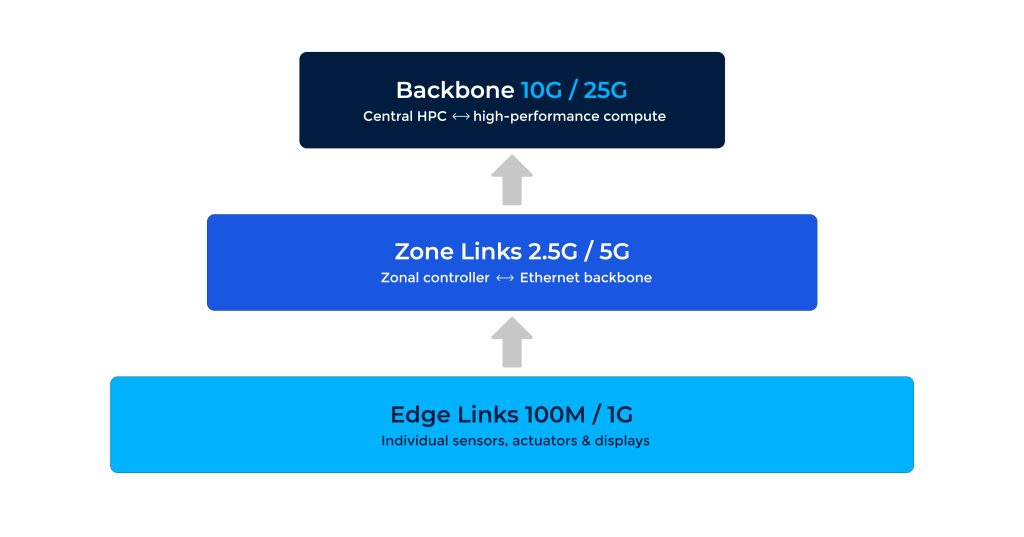
Multi-Gigabit Network Tiers
Not every component requires the same speed. Future vehicles may use multiple Ethernet tiers: lower-speed links at the edge, multi-gigabit connections for demanding sensors and zones, and 10G or 25G links across high-performance backbones and compute infrastructure.
The objective is not simply to make everything faster. It is to provide the right combination of bandwidth, latency, determinism, and reliability for each workload.
Networking Becomes a Strategic Technology Layer
As software-defined vehicles evolve, networking is moving from a supporting subsystem to a strategic part of vehicle architecture. Compute determines processing capability, sensors determine how much information the vehicle can perceive, and software determines what the vehicle can do with that information. The network determines how effectively these resources can work together.
Automotive Ethernet provides the scalable communication foundation. TSN adds predictable handling of time-sensitive traffic. Zonal architectures provide the physical and logical structure, while centralized HPC provides the computational capability. Together, they enable sensing, computing, and vehicle functions to operate as an integrated system.
How VVDN Can Support OEMs and Tier-1s
For OEMs and Tier-1 suppliers, adopting Automotive Ethernet and TSN requires expertise across networking hardware, embedded software, HPC, automotive systems, and validation.
VVDN can support this transition across the automotive networking and compute stack, including Automotive Ethernet and TSN-enabled networking platforms, Ethernet switch solutions, high-speed connectivity, and high-performance computing platforms for ADAS, AI, and other data-intensive workloads.
Our capabilities also extend to embedded software and automotive platforms, including Ethernet communication, middleware, diagnostics, AUTOSAR integration, and system-level software.
System validation is equally important. Automotive Ethernet and TSN networks need to be evaluated under realistic traffic loads, timing requirements, and failure conditions. VVDN can support hardware-software integration, network performance testing, interoperability, and system-level validation.
By bringing together Automotive Ethernet, TSN, HPC, embedded systems, and automotive engineering, VVDN can help OEMs and Tier-1s move from network architecture and proof-of-concept toward production-ready software-defined vehicle platforms.