






 Global
  United States
 Japan
Japan 






Aerospace and defence manufacturing operates in an environment where precision, reliability, traceability and repeatability are critical. Avionics, tactical communication systems, surveillance platforms, unmanned systems, radar equipment and defence electronics involve complex architectures, multiple configurations and demanding test requirements.
Testing these products requires more than simply checking whether a unit passes or fails. Manufacturers need automated systems that can execute complex test sequences, capture detailed measurements, identify anomalies and maintain complete product-level test records.
This is where Automated Test Equipment (ATE) becomes critical.
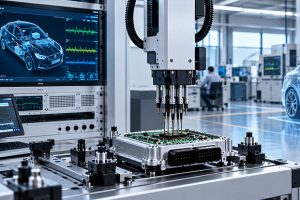
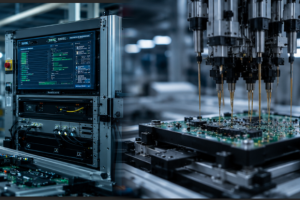
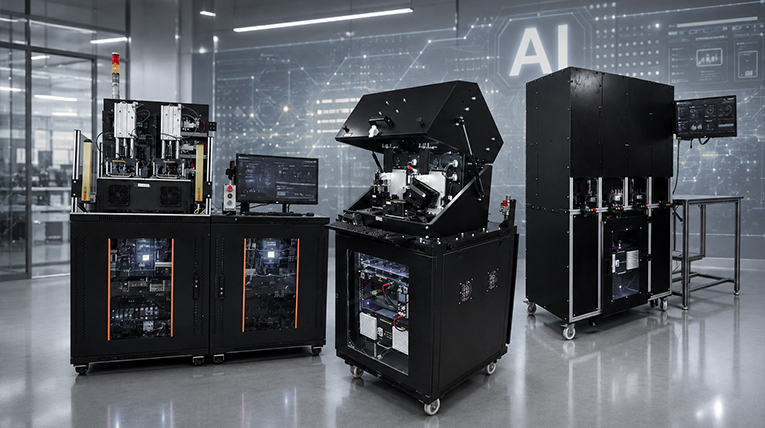
ATE brings together test instruments, fixtures, switching systems, data acquisition and test software to automate product testing. AI and advanced analytics can add another layer of intelligence, helping manufacturers extract greater value from the data generated during every test.
Table of Contents
Why Aerospace and Defence Manufacturing Needs Intelligent Test Automation
Aerospace and defence production often involves complex electronic assemblies, multiple product variants, stringent quality requirements and engineering changes throughout the product lifecycle.
Unlike highly standardised high-volume manufacturing, test systems may need to accommodate different configurations while maintaining consistent test coverage and traceability.
There is also a significant challenge around No Fault Found (NFF) and Intermittent Failures.
A unit may fail during production or field operation and subsequently pass when tested again under controlled conditions. Investigating these failures can require engineers to review test results, product configurations, component information, firmware versions and historical records.
AI-powered test analytics can correlate these datasets to identify patterns that may not be visible in an individual test result.
This creates several opportunities for intelligent ATE:
• Automating complex test sequences
• Reducing operator dependency
• Supporting multiple product configurations
• Improving test repeatability
• Capturing product-level test data
• Detecting abnormal test behaviour
• Supporting failure and root cause analysis
• Identifying trends before they become failures
From Automated Testing to Intelligent Test Automation
A conventional ATE system executes predefined test sequences, controls instruments, captures measurements and evaluates results against defined acceptance criteria.
AI does not replace these fundamental functions. Instead, it works alongside them.
Traditional ATE may determine that a product has passed a voltage, current, frequency, RF, or functional test. AI can analyse that measurement against historical production data and identify whether the result is behaving differently from an established baseline.
For example, a parameter can remain within its defined specification while gradually shifting across production batches. A conventional pass or fail system may not flag the change. An AI-powered analytics layer can identify the trend and provide an early indication for engineering investigation.
The evolution can therefore be viewed as:
Manual Testing → Automated Testing → Connected Testing → Intelligent Test Automation
The objective is not simply to test faster. It is to generate more useful engineering intelligence from every test.
How AI-Powered ATE Can Improve A&D Manufacturing
1. Intelligent Failure Analysis
A test failure does not always identify its root cause.
An avionics assembly, communication module, radar subsystem, or UAS electronic unit can fail at one test stage while the underlying issue originates from a component, firmware configuration, interface, fixture, or manufacturing process.
AI can correlate:
• Test measurements
• Failure codes
• Product configurations
• Firmware versions
• Component information
• Historical test results
• Batch information
• Test sequence behaviour
This can help engineers identify relationships between apparently unrelated failures and build more complete failure signatures.
For A&D manufacturers dealing with NFF and intermittent failures, this can significantly improve troubleshooting efficiency.
2. Anomaly Detection and Parameter Drift
A product does not necessarily have to fail a specification limit to indicate a potential problem.
A parameter may gradually move away from its historical baseline while remaining technically within specification. For mission-critical electronics, detecting this behaviour early can provide valuable time for engineering investigation.
AI-based anomaly detection can analyse historical production data to establish expected behaviour and flag unusual patterns in:
• Voltage and current measurements
• Frequency and timing parameters
• RF performance
• Temperature behaviour
• Communication interfaces
• Functional test parameters
• Component-level measurements
This allows manufacturers to move from reactive failure detection toward proactive quality monitoring.
3. Test Data Analytics
A complex ATE system can generate thousands of measurements during the testing of a single product.
Across production volumes, this creates a significant engineering dataset.
Instead of treating test results simply as pass or fail records, manufacturers can use analytics to identify:
• Recurring failure modes
• Parameter correlations
• Batch-level trends
• Configuration-related failures
• Fixture-related anomalies
• Component variation
• Process deviations
• Early indicators of quality issues
This creates a continuous feedback loop between test engineering, manufacturing engineering, quality, and product engineering.
ATE is the Engineering Foundation
AI is only as useful as the quality of the data it receives. This makes the underlying ATE architecture extremely important.
A robust aerospace ATE system requires appropriate test coverage, reliable instrumentation, repeatable fixtures, controlled software, accurate measurement, and well-defined acceptance criteria.
A typical architecture can include:
Product → Test Fixture → Switching & Instrumentation → Test Software → Data Acquisition → Analytics → Manufacturing Systems
The engineering behind each layer determines the quality and reliability of the resulting test data.
This is why ATE development should begin with the product and its test requirements rather than simply selecting test equipment.
Design for Test: Connects Engineering With Production
The effectiveness of production testing often starts much earlier than the production line.
Design for Test (DFT) allows engineering teams to consider how a product will be tested during development. Test access, measurement points, electrical interfaces, diagnostic capability, fixture requirements and test coverage can all influence the eventual manufacturability and testability of the product.
For aerospace and defence programs with long product lifecycles, this product-to-production connection can be particularly valuable. Designing for testability early can simplify production testing, improve diagnostics and provide greater flexibility as products evolve.
Connecting ATE With Manufacturing Automation
ATE becomes even more valuable when connected with the broader manufacturing environment. For high-mix aerospace and defence production, automated manufacturing can bring together:
Vision Inspection → Robotic Handling → Assembly → Functional Testing → Data Capture → Traceability
This allows product information to move through multiple manufacturing stages while maintaining a consistent digital record.
VVDN’s Aerospace and Defence ATE Capabilities
VVDN brings together product engineering, electronics manufacturing, production automation, and aerospace and defence expertise to develop test solutions around complex products.
Our Aerospace & Defence capabilities span tactical communications, intelligent surveillance, avionics and airborne systems, missile and precision-munition subsystems, UAS and defence computing infrastructure.
VVDN’s engineering and manufacturing processes align with applicable industry standards and compliance requirements, including AS9100:2016 Rev D, DO 178C Level B, and MIL-STD Compliance.
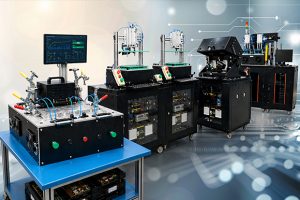
VVDN engineers Automated Test Equipment (ATE) systems tailored to the unique requirements of aerospace and defence products, including complex architectures, mission-critical electronics, stringent validation requirements, and demanding production environments.
From DFT, custom fixture and jig development to integration and support, we offer end-to-end ATE services.
Whether you are introducing a new aerospace or defence product, scaling production, improving test coverage, or replacing manual validation with automated infrastructure, VVDN provides the engineering depth to take your ATE journey from DFT analysis and test architecture to production-ready deployment.