






 Global
  United States
 Japan
Japan 







As manufacturing and product ecosystems become more complex, automation has evolved from an operational tool into a strategic business investment. Enterprises increasingly rely on automation across production, testing, validation, and analytics to optimise workflows, accelerate releases, and scale operations.
But one question remains critical: Is the automation investment truly delivering measurable ROI?
While many organisations focus only on labour reduction or short-term cost savings, the real value of automation extends far beyond that. Modern automation impacts manufacturing throughput, product quality, engineering productivity, release velocity, and long-term operational scalability.
For enterprises building complex products across electronics, embedded systems, telecom, automotive, consumer devices, and cloud-connected platforms, measuring automation ROI requires a far more comprehensive approach.
In this blog, we explore how enterprises can calculate, measure, and maximise the real ROI of automation across manufacturing, validation, and engineering ecosystems.
Table of Contents
Understanding Automation ROI Beyond Cost Savings
Traditionally, automation ROI has been measured using a simple financial formula:
ROI (%) =(( Benefits − Costs ) / Costs ) × 100
While this formula remains important, it only represents one dimension of automation success.
In modern engineering environments, automation creates value across multiple operational layers, including:
• Reduced production downtime
• Faster validation cycles
• Improved product quality
• Lower defect leakage
• Faster time to market
• Reduced engineering overhead
• Better manufacturing consistency
• Higher scalability across product lines
• Improved customer experience
As automation ecosystems become increasingly connected with AI, analytics, cloud infrastructure, and digital manufacturing systems, enterprises must evaluate ROI from both financial and operational perspectives.
Why Automation ROI Has Become Critical for Enterprises
Today’s product ecosystems are becoming increasingly complex, with shorter release cycles, rapid hardware and software updates, expanding device ecosystems, and rising quality expectations. At the same time, enterprises must manage growing validation workloads and smart manufacturing initiatives while maintaining speed and efficiency.
As this complexity continues to increase, manual processes often struggle to keep pace with the scale and demands of modern engineering and manufacturing environments. Automation helps enterprises address these challenges by accelerating engineering workflows, improving manufacturing efficiency, scaling testing operations, reducing dependency on manual intervention, and increasing process consistency, repeatability, and traceability.
However, automation projects that are not strategically planned often fail to deliver sustainable ROI. In many cases, organisations focus heavily on implementation while underestimating long-term factors such as maintenance effort, scalability requirements, and integration complexity.
As systems evolve, these challenges can gradually increase operational overhead and reduce the overall value delivered by automation initiatives.
Types of Automation ROI Enterprises Should Measure
One of the biggest mistakes companies make is measuring ROI only through direct cost savings. In reality, automation creates value across multiple business dimensions, and its impact extends far beyond immediate financial returns.
1. Financial ROI
Financial ROI focuses on measurable cost reductions and revenue-related improvements generated through automation. This can include reduced manual labour requirements, lower operational costs, reduced rework expenses, fewer defect-related losses, minimised downtime costs, and increased production output.
These benefits are commonly seen in manufacturing automation, production testing, automated inspection systems, and validation workflows.
2. Operational ROI
Operational improvements often deliver greater long-term business value than immediate cost reductions. Automation can increase production throughput, reduce cycle times, and improve machine utilization rates.
Higher operational efficiency directly impacts delivery timelines, resource utilization, and the ability to scale production effectively.
3. Quality ROI
Quality-related ROI is often underestimated. Automation strengthens test coverage, improves validation consistency and repeatability, enhances defect detection accuracy, increases product reliability, and supports compliance requirements.
In electronics manufacturing and embedded systems, reducing quality failures can lower recall risks, decrease warranty costs, improve customer satisfaction, and protect brand reputation, creating substantial long-term value.
4. Engineering Productivity ROI
Automation also improves engineering productivity by allowing teams to spend less time on repetitive tasks and more time on innovation. Faster regression execution, reduced debugging effort, quicker firmware validation, accelerated CI/CD workflows, and improved engineering efficiency all contribute to measurable gains.
This becomes particularly valuable in large-scale validation and development environments.
Hidden Costs That Often Reduce Automation ROI
Many automation initiatives underperform because organisations focus heavily on implementation costs while overlooking long-term maintenance and scalability challenges.
Maintenance Overhead
Automation systems require continuous updates as products evolve, including test scripts, firmware compatibility, APIs, and infrastructure changes. Poorly designed frameworks can become costly to maintain.
Flaky Automation Systems
Unstable automation environments can increase manual intervention, debugging effort, and false failures, reducing overall engineering efficiency.
Poor Automation Architecture
Automation built without scalability in mind can create integration bottlenecks, tool fragmentation, infrastructure complexity, and limited framework reusability.
Skill and Training Costs
Automation ecosystems often require expertise across hardware, software, cloud platforms, AI, and CI/CD systems, making training and enablement important long-term investments.
Measuring Automation Success Beyond ROI
While ROI remains an important benchmark, organisations should continuously track performance indicators that reveal the broader impact of automation on manufacturing, validation, and engineering operations.
Key metrics that organisations should monitor include:
| KPI | Why It Matters |
| Production Throughput | Measures manufacturing efficiency |
| First Pass Yield (FPY) | Indicates manufacturing quality |
| Overall Equipment Effectiveness (OEE) | Measures equipment utilization |
| Defect Leakage Rate | Measures escaped defects |
| Mean Time to Repair (MTTR) | Indicates operational recovery speed |
| Test Cycle Duration | Measures validation efficiency |
| Release Velocity | Tracks engineering agility |
| Downtime Reduction | Measures operational continuity |
| Automation Coverage | Indicates the scalability of validation |
| Resource Utilization | Tracks manpower optimization |
These metrics provide a far more accurate understanding of automation impact than cost calculations alone.
Why These Metrics Matter
Tracking these automation KPIs helps organisations move beyond simple cost calculations and gain a deeper understanding of business impact. Improvements in throughput, quality, release velocity, and equipment utilization often generate greater long-term value than direct labour savings alone. These metrics also provide measurable evidence of how automation supports digital transformation, manufacturing excellence, continuous improvement, and scalable product development.
By adopting a data-driven approach to automation performance measurement, enterprises can identify optimisation opportunities, justify future investments, and ensure that automation initiatives remain aligned with business objectives. Ultimately, successful automation is not defined by cost reduction alone but by its ability to improve efficiency, enhance quality, accelerate innovation, and support sustainable growth across the organisation.
The Role of AI in Improving Automation ROI
AI is transforming automation by making systems more intelligent, efficient, and adaptive. Beyond automating repetitive tasks, AI helps reduce manual effort, improve decision-making, and increase the value generated from automation investments.
Key AI-driven capabilities include:
Predictive Failure Analytics
Identifies equipment degradation, production risks, and quality issues before they impact operations, reducing downtime and improving productivity.
AI-Based Inspection / AOI
Improves defect detection accuracy and accelerates quality inspection, reducing manual effort and manufacturing errors.
Self-Healing Test Automation
Automatically adapts to workflow and interface changes, reducing maintenance effort and improving framework reliability.
Intelligent Root Cause Analysis
Analyses logs and operational data to identify failures faster, reducing debugging effort and accelerating issue resolution.
By integrating AI with automation frameworks, enterprises can build more adaptive, predictive, and resilient operations that deliver sustained business value.
Why Scalable Automation Architecture Matters
AI capabilities alone do not guarantee long-term success. The underlying automation architecture must also scale effectively. Modern automation ecosystems should support multi-product validation, cloud connectivity, CI/CD integration, real-time analytics, and reusable frameworks.
Without scalability, automation systems can eventually become operational bottlenecks rather than efficiency drivers.
How VVDN Enables Enterprise Automation Success
At VVDN Technologies, automation is viewed as more than implementing tools or replacing manual processes. It is approached as an end-to-end engineering transformation strategy designed to improve efficiency, accelerate innovation, and create measurable business value across the product lifecycle.
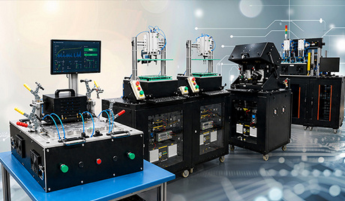
VVDN enables enterprises to build intelligent automation ecosystems through capabilities spanning Automated Test Equipment (ATE), manufacturing automation, embedded validation systems, hardware and firmware testing, AI-enabled inspection solutions, cloud-integrated automation platforms, and production analytics with real-time monitoring.
By bringing together expertise across hardware, software, cloud technologies, AI, and manufacturing engineering, VVDN helps organisations streamline operations, improve product quality, accelerate time to market, and build scalable systems that support long-term growth.
Explore how VVDN’s automation and engineering capabilities help enterprises transform production and validation processes.