





 Global
  United States
 Japan
Japan 






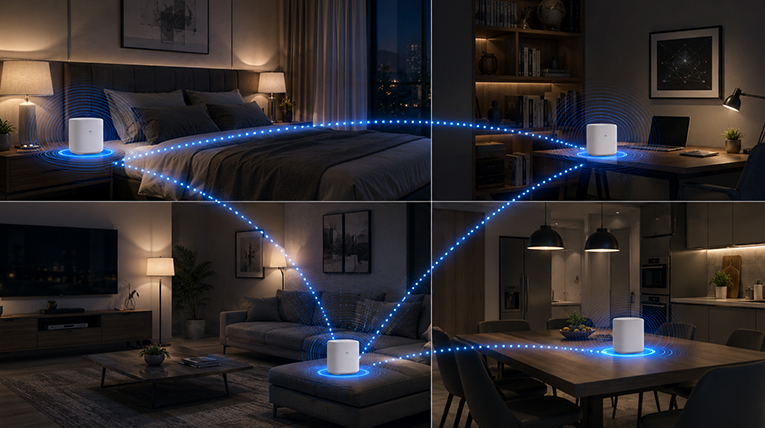
Imagine walking through a corporate campus while attending a video conference. As you move between access points, the connection remains stable, the video continues without interruption and the user experience remains seamless. This level of reliability is becoming essential across enterprises, homes, hospitality and public Wi-Fi deployments.
Wi-Fi 7 is redefining wireless connectivity with technologies such as Multi-Link Operation (MLO), 320 MHz channels, 4K-QAM and ultra-low latency, enabling support for bandwidth-intensive and latency-sensitive applications. However, higher performance alone is not enough – modern networks require intelligent coordination across multiple access points.
For OEMs, Internet Service Providers (ISPs) and Telecom Service Providers (TSPs), the challenge is delivering scalable, intelligent and easily managed Wi-Fi experiences with consistent performance.
This is where Wi-Fi EasyMesh becomes critical. By enabling multiple access points to operate as a coordinated network, EasyMesh enhances Wi-Fi 7 deployments with seamless roaming, optimized resource utilization, centralized management and improved Quality of Experience (QoE). Building an EasyMesh solution requires more than wireless hardware integration, it demands expertise across embedded software, firmware, cloud platforms, interoperability testing and lifecycle engineering.
Table of Contents
Why Wi-Fi 7 Needs EasyMesh
As Wi-Fi deployments grow in size and complexity, standalone access points struggle to deliver consistent coverage and performance. Network congestion, overloaded access points, inefficient roaming and manual management can impact user experience.
EasyMesh addresses these challenges by transforming multiple access points into a unified, intelligent network.
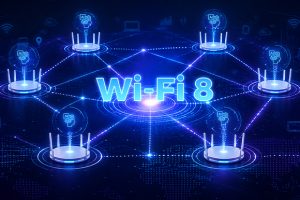
An EasyMesh deployment consists of three primary components:
Controller – The intelligence layer responsible for managing network topology, configuration, optimization decisions and communication between mesh nodes.
Agents – Individual access points that provide wireless connectivity while exchanging network information with the Controller and executing optimization decisions.
Backhaul – The communication link between mesh nodes, which can use wired Ethernet or wireless connectivity depending on deployment requirements.
Together, these components enable a self-organizing multi-AP network that can adapt to changing traffic conditions, device density and user mobility.
Beyond Hardware: The Software Architecture Behind EasyMesh
Delivering a carrier-grade EasyMesh solution requires integration across multiple software layers. Each layer contributes to network performance, scalability, security and manageability.
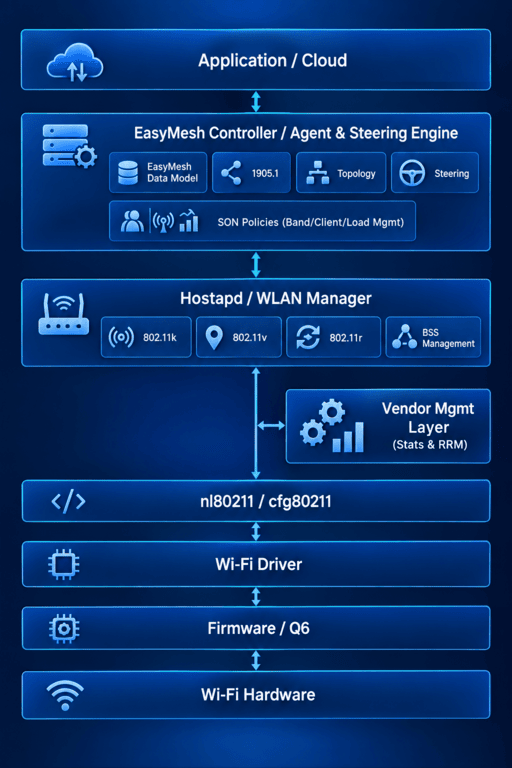
Building this software stack requires chipset SDK customization, platform integration, firmware optimization and extensive validation to ensure reliable operation across different hardware and client ecosystems.
For ISPs and TSPs, cloud integration enables centralized provisioning, remote diagnostics, telemetry collection, policy management, analytics and over-the-air (OTA) firmware updates across large-scale deployments. Support for remote management standards such as TR-369 (User Services Platform) and TR-069 further simplifies broadband device lifecycle management.
Engineering Challenges in Building EasyMesh Solutions
Although EasyMesh provides a standardized multi-AP framework, converting it into a commercial product requires solving several complex engineering challenges.
Chipset SDK and Platform Integration
Different chipset platforms provide unique SDKs, APIs, and feature implementations. Integrating these capabilities with Linux-based platforms such as OpenWrt or prplOS while maintaining performance, security, and compatibility requires strong embedded software expertise.
Controller-Agent Development
The Controller and Agent components must continuously exchange topology, client, and network information while coordinating optimization decisions in real time. Efficient implementation is critical for scalable deployments and responsive network management.
Intelligent Roaming Optimization
Seamless mobility requires more than moving clients between access points. Engineering teams optimize roaming behavior using standards such as IEEE 802.11k, 802.11v, and 802.11r, along with intelligent client steering algorithms, to minimize interruptions for applications such as voice calls, video conferencing, cloud gaming, and enterprise mobility.
Multi-Vendor Interoperability and Certification
OEMs and service providers often deploy diverse client devices, chipsets, and networking equipment. Ensuring consistent EasyMesh behavior requires extensive interoperability testing, firmware validation, and compliance with Wi-Fi Alliance certification requirements.
Cloud Enablement and Lifecycle Management
Modern Wi-Fi deployments require continuous monitoring and management after deployment. Cloud platforms support device provisioning, diagnostics, analytics, security updates, policy management, and long-term firmware maintenance.
Accelerating EasyMesh Development Through End-to-End Software Engineering
Wi-Fi EasyMesh is an open Wi-Fi Alliance standard, and open-source reference implementations exist to help teams get started. But turning that starting point into a certified, carrier-grade product is a different challenge entirely. It requires chipset SDK integration across vendors, platform integration across Linux-based environments, real-time Controller-Agent development, cloud enablement for remote management, and extensive interoperability testing to meet Wi-Fi Alliance certification requirements.
Managing these disciplines independently increases development time, integration risk, and long-term support costs. VVDN Technologies works as an end-to-end ODM partner across the complete EasyMesh product lifecycle, including:
- Wi-Fi chipset SDK integration and customization across leading SoC vendors
- Platform development across a range of Linux-based environments
- EasyMesh Controller and Agent implementation
- Wireless driver and middleware integration
- Cloud management and remote device management enablement
- Security hardening and firmware optimization
- Interoperability and certification testing
- Sustenance engineering and long-term software support
Conclusion
Wi-Fi 7 establishes a new benchmark for wireless performance, but delivering seamless connectivity requires intelligent coordination across multiple access points. EasyMesh provides the software intelligence needed to transform high-performance hardware into a unified, adaptive, and manageable network.
For OEMs, ISPs, and TSPs, building carrier-grade EasyMesh solutions requires expertise across chipset integration, embedded software, cloud enablement, interoperability, certification, and lifecycle support.
With capabilities spanning networking product engineering, embedded software development, cloud platforms, testing, and manufacturing, VVDN Technologies helps customers accelerate the development of scalable Wi-Fi 7 EasyMesh solutions from concept and engineering to mass production and long-term lifecycle support.
Click here to learn more about our offerings or contact us at info@vvdntech.in