
 Global
 United States
  Japan
Japan 



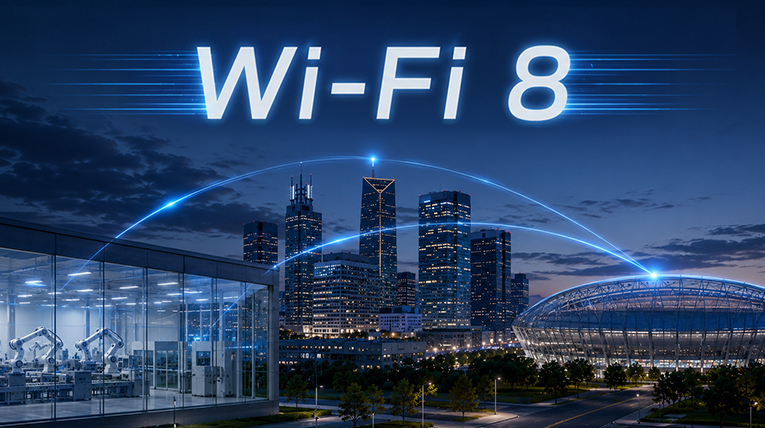
Wi-Fi 8 (IEEE 802.11bn) marks a decisive shift in wireless evolution, from chasing peak throughput to delivering predictable, reliable, and deterministic connectivity. While previous generations like Wi-Fi 6 and Wi-Fi 7 pushed the limits of speed and spectral efficiency, real-world networks still struggle with inconsistent performance in dense, interference-heavy and mobile environments. Wi-Fi 8 is designed to solve this gap.
Built under the Ultra High Reliability (UHR) framework, Wi-Fi 8 focuses on guaranteed performance under real conditions, not just lab-based peak rates. It introduces coordinated multi AP operation, intelligent scheduling, and advanced interference management to ensure that latency, packet loss and throughput remain tightly controlled, even in the most challenging deployments.
This is critical as wireless becomes the backbone for next-generation applications such as AR/VR, industrial automation, AI-driven workloads, and cloud gaming, where consistency matters more than peak speed. Wi-Fi 8 brings wireless closer to a wired experience, enabling networks to deliver stable throughput, ultra-low latency and seamless mobility at scale. Wi-Fi 8 is not just an upgrade, it is a redefinition of wireless performance, setting a new benchmark for how networks are built, managed and experienced.
Table of Contents
Wi-Fi 8: Core Capabilities and Innovations
Intelligent Multi-AP Coordination
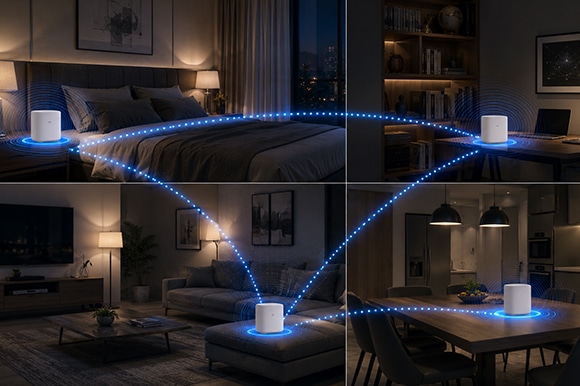
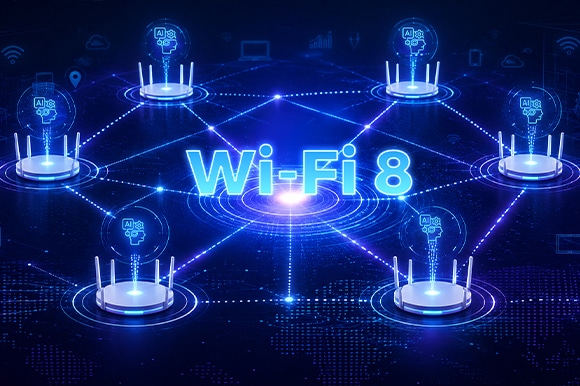
Wi-Fi 8 transforms dense networks by enabling coordinated AP operation rather than independent functioning. Using CO-BF (coordinated beamforming), CO-SR (coordinated spatial reuse), and CO-TDMA (coordinated time division multiple access), access points exchange real time information on channel conditions, traffic load, and client distribution. NPCA (Non-Primary Channel Access) ensures efficient channel access and coordination across the network. The result is reduced interference, predictable throughput, and efficient airtime usage, critical for offices, campuses, stadiums and multi-dwelling units.
Extended Coverage and Consistent Throughput
Wi-Fi 8 prioritizes performance stability across range, not just peak speeds near the AP. Enhanced DRU (distributed tone resource units), long-range transmission techniques, and adaptive MCS (modulation and coding scheme) allow signals to adjust to varying conditions, providing smooth and reliable connectivity even at the far edges of coverage. Users moving between rooms, floors or hallways experience minimal drops, supporting real-time applications without interruption.
Fair and Efficient Multi-User Performance
Modern networks must serve a mix of devices and applications simultaneously. Wi-Fi 8 uses EDCA (Enhanced Distributed Channel Access), UEQM (Unequal Modulation), and Dynamic Sub-Band Operation to intelligently allocate resources across users and applications. This enables the network to dynamically adjust transmission priority, modulation levels and sub-band allocation based on traffic type and real-time channel conditions. Latency-sensitive applications such as video conferencing, AR/VR, cloud gaming and industrial control receive deterministic, high-priority performance, while background traffic continues without disruption.
Seamless Roaming and Handoff
Wi-Fi 8 delivers near-seamless roaming in large enterprises, campuses or public venues. Pre-coordination between APs and dynamic scheduling ensures fast, smooth handoffs with minimal packet loss or latency, allowing uninterrupted connectivity for real-time applications and immersive experiences like AR/VR etc.
Reliable Edge Connectivity and Interference Mitigation
Wi-Fi 8 enhances reliability at the network edge by ensuring consistent signal quality in environments where multiple access points operate in proximity. It improves receiver sensitivity and leverages coordinated spatial reuse (CO-SR) along with network-level scheduling to minimize interference overlap. This allows edge devices to maintain stable connectivity and predictable throughput even in highly dense deployment scenarios.
Adaptive Spectrum Management and Coexistence
Wi-Fi 8 introduces smarter spectrum utilization, dynamically allocating channels and coordinating APs to maximize efficiency. It ensures coexistence with other radios such as Bluetooth and UWB, preventing internal and external interference. This is particularly important for dense residential, enterprise and industrial environments where multiple radios operate simultaneously.
Energy-Efficient Operation
With increasing device density, Wi-Fi 8 improves power efficiency by reducing unnecessary transmissions and optimizing activity using coordinated scheduling and DRU. This extends battery life for clients and reduces operational costs for large-scale deployments, all while maintaining high performance.
Who Needs Wi-Fi 8: Deployments Driving the Next Wave
Wi-Fi 8 is designed for environments where network performance must be consistent, predictable and reliable at all times. As wireless becomes the primary access layer, the challenge is no longer peak speed but the ability to maintain stable latency, minimize interference, and deliver a uniform experience across users and locations. Wi-Fi 8 addresses this by introducing network-level coordination, intelligent scheduling and real-time adaptation, enabling wireless networks to behave more like deterministic systems rather than best-effort connections.
- In enterprise campuses and corporate offices, dense access point deployments and high device counts often result in contention and uneven performance. Wi-Fi 8 enables access points to operate in a coordinated manner, sharing channel and traffic intelligence to reduce collisions and optimize airtime usage. This ensures consistent throughput and low latency across meeting rooms, open workspaces and multi-floor deployments, even during peak usage.
- In large public venues such as stadiums, airports and convention centers, the primary challenge is handling massive concurrency without performance degradation. Wi-Fi 8 introduces more controlled and scheduled transmissions along with advanced interference management, allowing thousands of devices to operate simultaneously while maintaining stable connectivity and user experience.
- For industrial and mission-critical environments, including manufacturing, warehouses and automation-driven facilities, reliability is non-negotiable. Wi-Fi 8 enhances link stability and edge performance by adapting to changing signal conditions and minimizing packet loss, enabling seamless operation of robotics, autonomous systems and real-time monitoring applications.
- In residential deployments and multi-dwelling units, overlapping networks create interference and unpredictable performance. Wi-Fi 8 improves coexistence by dynamically adjusting spectrum usage based on real-time conditions, allowing neighboring networks to operate more efficiently and delivering a more uniform experience across apartments without manual intervention.
- For next-generation applications such as AR/VR, cloud gaming and AI-driven workloads, performance consistency is critical. Wi-Fi 8 ensures low latency and minimal jitter by intelligently prioritizing traffic and allocating resources dynamically, enabling smooth, immersive and real-time user experiences.
Comparison of Wi-Fi 8 vs Wi-Fi 7 vs Wi-Fi 6/6E vs Wi-Fi 5
| Wi‑Fi 8 | Wi‑Fi 7 | Wi‑Fi 6 / 6E | Wi‑Fi 5 | |
| IEEE Standard | (802.11bn) | (802.11be) | (802.11ax) | (802.11ac) |
| Core Focus | Ultra‑High Reliability (UHR): predictable performance under load and interference | Extremely High Throughput (EHT): speed + capacity | Efficiency + capacity | Speed boost over older Wi‑Fi |
| Frequency Bands | 2.4/ 5/ 6 GHz | 2.4/ 5/ 6 GHz | 2.4/ 5 GHz (6E adds 6 GHz) | 5 GHz |
| Channel Bandwidth | Up to 320 MHz | Up to 320 MHz | Up to 160 MHz | Up to 160 MHz |
| Peak PHY Rate | Up to ~46 Gbps (focus on sustained performance) | Up to ~46 Gbps | Up to ~9.6 Gbps | ~3.5 Gbps |
| Modulation (QAM) | 4096‑QAM & enhanced MCS for robust performance | 4096‑QAM | 1024‑QAM | 256‑QAM |
| MU‑MIMO Spatial Streams | 16×16 | 16×16 | 8×8 | 4×4 |
| Multi‑Link Operation (MLO) | Yes (continued) | Yes | No | No |
| Multi‑AP Coordination | Yes: CO‑SR, CO‑BF, coordinated scheduling, NPCA | No | No | No |
| Dynamic Sub‑Band Operation (DSO) / NPCA | Yes | No | No | No |
| Distributed Resource Units (DRU) | Yes | No | No | No |
| Enhanced Long Range (ELR) | Yes | Standard | Standard | Standard |
VVDN and Wi‑Fi 8: Your Path to Next-Gen Wireless
Wi-Fi 8 is set to redefine wireless with ultra-reliable, low latency and high density performance. At VVDN, we are preparing our R&D to help customers leverage these next-generation features without delay.
Even though Wi-Fi 8 is emerging, VVDN can develop customized Wi-Fi 8 access points tailored to your enterprise, industrial, or home networking needs, ensuring faster time to market and a smooth transition to next-generation wireless. Partner with us to bring Wi-Fi 8 from concept to deployment and stay ahead of the curve.
For more information about our Wi-Fi solutions, reach out to our experts at info@vvdntech.com