





 Global
  United States
 Japan
Japan 






The medical device industry is evolving faster than ever. Rising demand for precision, regulatory compliance, shorter innovation cycles, and patient-specific solutions is reshaping how products are designed and manufactured.
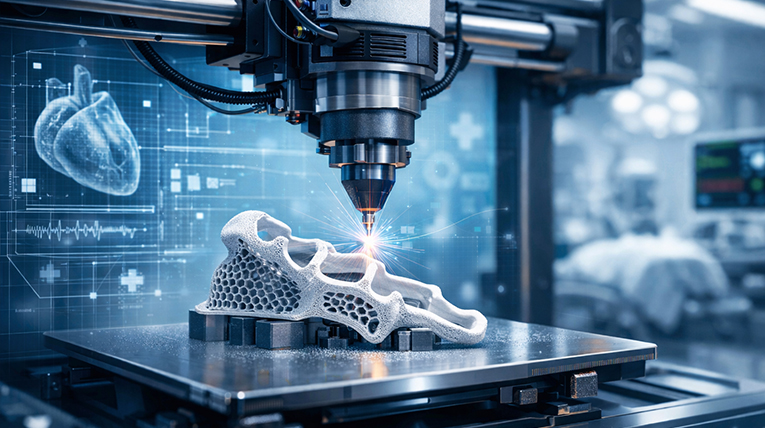
At the center of this transformation is 3D printing (additive manufacturing) — a technology experiencing rapid global growth. Driven by advancements in materials, software and digital workflows, 3D printing empowers healthcare companies to accelerate innovation, reduce development costs, and deliver highly customized solutions.
From personalized implants to rapid prototyping of diagnostic systems and wearable healthcare devices, additive manufacturing is redefining the future of medical device development.
In this blog, we explore how 3D printing is revolutionizing medical device design, accelerating prototyping, enabling production-scale customization, and shaping compliant healthcare manufacturing.
Table of Contents
Understanding 3D Printing in the Medical Device Ecosystem
3D printing is an additive manufacturing process in which objects are built layer by layer from digital CAD models. Unlike traditional subtractive manufacturing, which removes material, additive manufacturing creates parts with minimal waste and unmatched design flexibility.
Common materials used in medical 3D printing include:
- Engineering-grade Polymers
- Medical-grade Resins
- Metals Such as Titanium and Stainless Steel
- Biocompatible and Sterilizable Materials
Within the medical ecosystem, 3D printing enables the production of complex, high-precision and patient-specific components that would be expensive—or even impossible—to manufacture using conventional methods.
The ability to convert digital designs into functional components within hours makes this technology invaluable in an industry where speed, accuracy, validation and compliance are critical.
Why 3D Printing Is Strategically Important for Medical Devices
The medical device sector demands:
- Precision
- Regulatory Compliance
- Customization
- Faster Time-to-market
3D printing directly addresses these requirements by offering:
- Faster Iteration During Early Stage Development
- Cost-effective Prototyping
- Design Flexibility for Complex Geometries
- Patient-specific Customization
- Reduced Material Waste
- Shorter Product Development Cycles
As healthcare increasingly shifts toward personalized treatment, additive manufacturing has become a key enabler of innovation.
High-Impact Applications in Healthcare
3D printing is already transforming multiple medical device categories, including:
- Prosthetics and Orthotics
- Surgical Instruments and Guides
- Diagnostic Device Enclosures
- Wearable Medical Devices
- Dental and Orthopedic Components
- Anatomical Models for Surgical Planning
These applications demonstrate how digital manufacturing can improve clinical outcomes while reducing development complexity.
Advancing Medical Device Design Through Additive Manufacturing
Traditional manufacturing often limits engineers due to tooling constraints, mold lead times, and production complexity.
With 3D printing, design freedom expands significantly.
Engineers can now:
- Create Complex Geometries Without Tooling Costs
- Develop Lightweight and Ergonomic Designs
- Integrate Internal Channels and Intricate Structures
- Customize Devices for Individual Patients
Design updates can be implemented directly in CAD software and produced within hours instead of waiting weeks for molds or machined parts. This dramatically reduces design cycles and accelerates product innovation.
Accelerating Prototyping and Validation
Prototyping is one of the most impactful applications of 3D printing in medical devices.
Instead of relying on traditional machining or injection molding, teams can:
- Quickly Validate Design Concepts
- Test Form, Fit and Function
- Conduct Usability and Ergonomic Assessments
- Identify Design Flaws Early in Development
Rapid prototyping minimizes development risk and supports faster regulatory preparation. Companies can move from concept to functional prototypes in days rather than months — significantly improving time-to-market.
Enabling Production and Mass Customization
3D printing has moved beyond prototyping. It is now widely used for low-volume production and customized medical devices.
Key production benefits include:
- On-demand Manufacturing
- Reduced Inventory and Warehousing
- Batch Customization
- Faster Production Turnaround
- Localized Manufacturing Capabilities
For products such as prosthetics, surgical guides, and wearable healthcare devices, additive manufacturing enables mass customization without substantially increasing costs.
This shift toward digital manufacturing is transforming medical device supply chains worldwide.
The Future of 3D Printing in Healthcare
As materials evolve, print precision improves, and regulatory frameworks mature, 3D printing will play an even greater role in medical innovation.
Future growth areas include:
- Advanced Biocompatible Materials
- Implantable Device Components
- AI-driven Design Optimization
- Point-of-Care Manufacturing
- Smart and Connected Wearable Medical Devices
3D printing is no longer just a prototyping tool — it is becoming a core manufacturing technology in modern healthcare.
Partner with VVDN for Medical Device 3D Printing
VVDN Technologies supports medical device companies with end-to-end product engineering, rapid prototyping, and advanced manufacturing solutions — including high-precision 3D printing services.
As an ISO 13485-certified organization, VVDN operates under a robust Quality Management System (QMS) aligned with global medical device regulatory standards.
Whether developing a next-generation medical device, validating an innovative concept, or preparing for compliant production scale-up, VVDN helps accelerate development while maintaining stringent quality and regulatory compliance.
Ready to Accelerate Your Medical Device Innovation?
Connect with VVDN to leverage ISO 13485-certified 3D printing and transform your concepts into compliant, market-ready healthcare solutions.