
 Global

 United States
 Japan


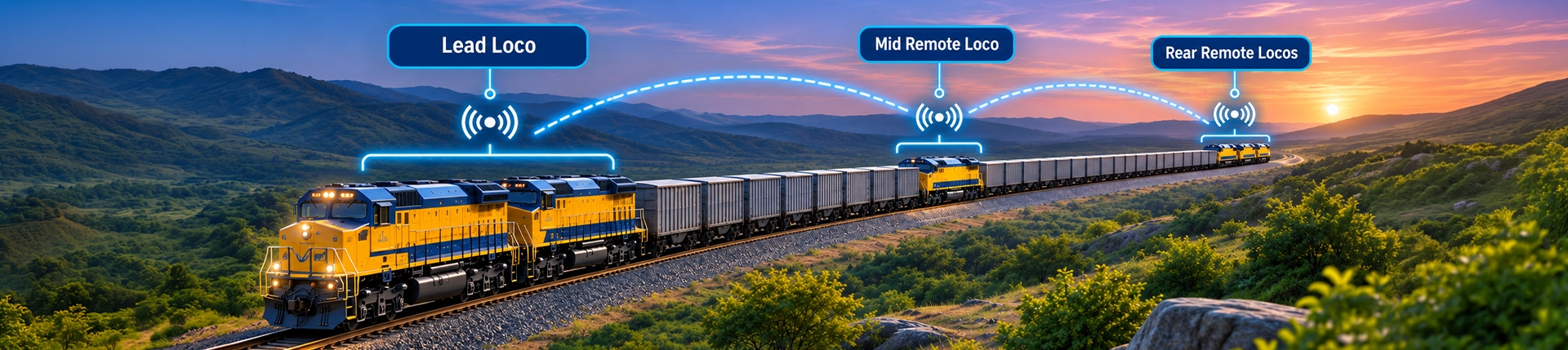
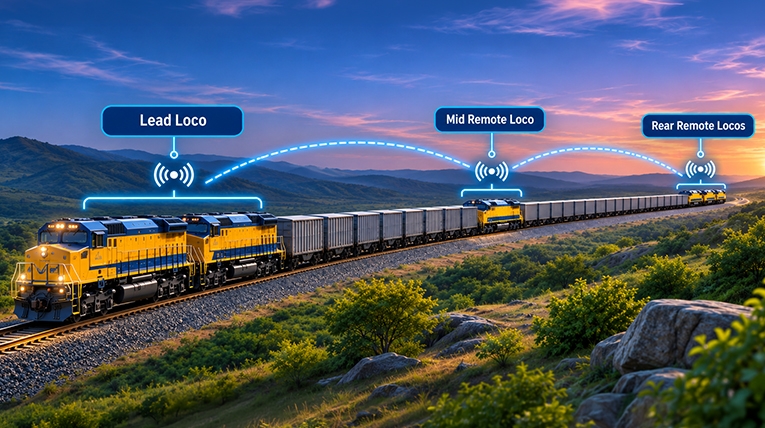
Global freight operators are under constant pressure to increase train lengths, maximize cargo throughput, and improve energy efficiency without compromising safety. However, running ultra-long freight often consists of stretching two to three kilometers. With all locomotive power concentrated at the front creates severe operational bottlenecks. High in-train coupler forces, delayed pneumatic brake propagation along the brake pipe, and elevated risks of train parting limit how efficiently heavy-haul networks can scale.
To overcome these physical constraints, rail operators worldwide rely on Wireless Distributed Power (DP) also known as Wireless Multiple-Unit (MU) Control or Distributed Power Wireless Control Systems (DPWCS). By placing unmanned remote locomotives in the middle or at the rear of a freight train and synchronizing them with the lead locomotive over a mission-critical wireless link, Distributed Power transforms how heavy-haul trains accelerate, brake, and navigate steep gradients.
At VVDN Technologies, our rail engineering and manufacturing teams design and build the foundational hardware that makes wireless consist control possible from custom ruggedized UHF radio modems to complete onboard control subsystems.
Table of Contents
How Wireless Distributed Power Works
In traditional wired MU configurations, physical jumper cables carry throttle, dynamic braking, and direction commands between adjacent locomotives. Once locomotives are separated by dozens of freight wagons, physical cabling is no longer viable.
Wireless Distributed Power replaces that physical link with a deterministic, bidirectional RF telemetry network:
- Lead Locomotive (Master): Houses the Driver Interface Unit (DIU) and Control & Communication Unit (CCU). When the locomotive pilot adjusts the throttle, dynamic brake, or automatic air brake, the CCU encodes these commands into secure data packets.
- Mission-Critical RF Link: A ruggedized onboard radio modem transmits these packets across the length of the train—and through challenging terrain—to the remote units.
- Remote Locomotives (Slaves): Receive the commands via their onboard radio modems, validate message integrity, and execute synchronized traction and braking responses through dedicated Brake Interface Units (BIUs) while continuously streaming health and brake-pipe pressure telemetry back to the lead cab.
Because braking air is simultaneously vented or charged from multiple points along the train, brake application and release times drop dramatically, reducing stopping distances and minimizing longitudinal slack action.
Key Hardware & RF Engineering Challenges in Rail Environments
Designing a wireless control system for heavy-haul rolling stock is fundamentally different from commercial wireless networking. A single dropped command or delayed packet in a 10,000+ ton freight train can compromise operational safety. Engineering teams must solve several harsh-environment challenges:
1. High-Noise Electromagnetic Environments (EMI/EMC)
Modern locomotives operate beneath high-voltage overhead catenary lines (25 kV AC) and alongside high-power traction inverters that generate intense electromagnetic interference. Radio modems and control units require multi-stage RF front-end filtering, shielded enclosures, and galvanic isolation to maintain clean signal-to-noise ratios without receiver desensitization.
2. Multipath Fading, Tunnels, and Terrain Obstructions
Freight corridors pass through deep cuttings, curved mountain passes, dense urban yards, and long tunnels where line-of-sight propagation breaks down. RF architectures must operate in high-penetration licensed UHF bands, utilizing forward error correction (FEC), and intelligent repeater or store-and-forward protocols to guarantee deterministic link availability.
3. Fail-Safe Communication Loss Handling
In mission-critical rail telemetry, the system must distinguish between momentary RF shadowing and an actual communication failure. Deterministic watchdog timers, encrypted heartbeat frames, and pre-programmed fail-safe states ensure that if communication is lost beyond a strict threshold, remote locomotives automatically transition to idle or apply controlled penalty braking.
4. Extreme Mechanical and Thermal Stress
Rolling stock electronics endure continuous shock, multi-axis vibration, dust ingress, humidity, and wide ambient temperature swings (-40°C to +70°C). All PCBs, connectors, and mechanical housings must be engineered for long operational lifecycles with minimal maintenance.
VVDN’s End-to-End Capabilities in Distributed Power Hardware
As a global provider of rail product engineering and electronics manufacturing services, VVDN supports rail OEMs and Tier-1 subsystem integrators across the entire hardware lifecycle from initial RF architecture to high-reliability box-build production.
- Custom Ruggedized Radio Modems: VVDN designs and manufactures high-reliability UHF/RF data modems tailored for train-to-train and train-to-wayside telemetry. Our RF engineering covers custom transceiver lineup design, high-linearity power amplification, anti-interference filtering, and antenna impedance matching for locomotive rooftop installations.
- Complete Subsystem Box-Build: Beyond standalone modems, VVDN engineers and integrates complete Distributed Power electronic suites, including Control & Communication Units (CCUs), Brake Interface Units (BIUs), Driver Interface Units (DIUs), and power supply modules.
- Global Rail Standards Compliance: Our hardware architectures are built from the ground up to meet stringent international rolling stock standards, including EN 50155 (electronic equipment used on rolling stock), EN 50121-3-2 (electromagnetic compatibility), IEC 61373 (shock and vibration).
- In-House Validation & Manufacturing: With dedicated RF chambers, EMI/EMC pre-compliance labs, environmental stress screening (ESS), and SMT/box-build manufacturing facilities in India, VVDN accelerates time-to-market while maintaining full traceability and quality control.
Enabling the Future of Connected, Heavy-Haul Rail
As global rail networks modernize toward higher axle loads, longer freight consists, and automated train operations, wireless distributed power remains one of the highest-ROI technologies for fleet operators. By combining deterministic RF engineering, ruggedized embedded hardware, and scalable manufacturing, VVDN empowers rail OEMs to deploy reliable wireless consist control systems built for the world’s toughest rail corridors.
Looking to develop or manufacture next-generation railway communication hardware or ruggedized RF modems? Connect with VVDN’s rail engineering team at info@vvdntech.com to explore how we can accelerate your product roadmap.