
 Global
 United States
  Japan
Japan 



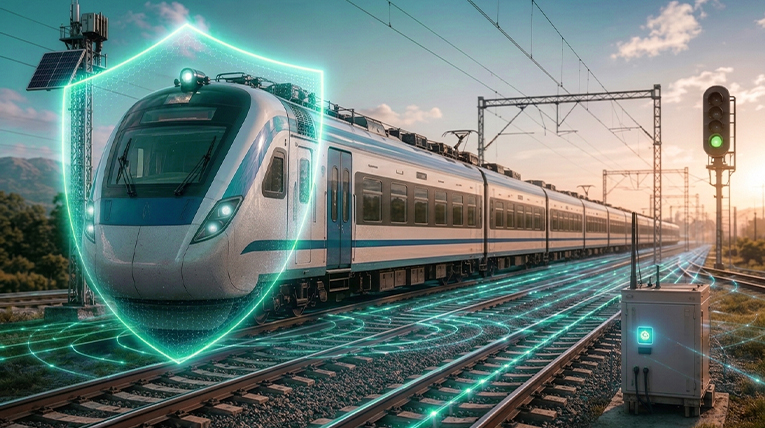
Indian Railways runs one of the densest, most complex networks in the world, tens of thousands of route kilometres, mixed traffic of freight and high-speed passenger trains and stretches where dense fog can cut visibility to almost nothing. In an environment like that, the margin for human error is thin and the cost of a Signal Passed at Danger (SPAD) or a missed brake application is measured in lives, not just delays.
Globally, the answer to this problem has been Automatic Train Protection (ATP) systems that continuously watch a train’s speed & position and apply the brakes if the locopilot doesn’t. Europe built ETCS for this purpose, but importing that system across a network in the size of India’s, would have meant an estimated price tag at several times the cost of an indigenous alternative. That gap between the safety outcome India needed and what an imported system would cost to deploy at scale, is exactly the problem KAVACH was built to solve.
Table of Contents
Technology Overview
KAVACH is India’s indigenously developed Automatic Train Protection system, built by the Research Designs and Standards Organisation (RDSO) together with Indian industry partners.
Architecture is two-sided:
- Trackside: A station side control unit and a radio unit, working alongside an array of passive RFID tags fixed to the sleepers that give the system a continuous, ground-truth read on train location and direction.
- Onboard (locomotive): A locomotive side control unit with vital computers, connected to RFID reader, speed sensor, brake interface unit, radio unit and Driver Machine Interface (DMI) display in the cab that shows the loco pilot, the signal aspects and movement authority independent of outside visibility.
Communication: The two sides talk over UHF radio, on spot frequencies in the 406–470 MHz band, with the system designed to be forward-compatible with 4G LTE as that layer is progressively rolled out.
Computing Architecture: Safety-critical computation on both the loco and station sides runs on a 2oo2 vital computer architecture, with GNSS clocks keeping loco and station KAVACH units in real-time, hot-standby synchronization, so no single computing fault can silently degrade the protection function.
Core safety functions:
- Automatically applies the brakes if a loco pilot misses a red signal or exceeds the permitted speed, no human intervention required.
- Supports safe running during dense fog, since the in-cab display gives signal information independent of outside visibility.
- Can broadcast emergency alerts to every train within a defined radius during a crisis.
Certification: Safety Integrity Level 4 (SIL-4), the highest safety classification used in railway signalling, keeps KAVACH in the same safety tier as the international systems it was built to replace.
What’s New
KAVACH 4.0 marks a significant advancement in India’s railway safety modernization journey, with the latest version moving into an accelerated phase of nationwide deployment. The rollout is gaining momentum, with ~1,500 route kilometres already covered through deployment milestones, alongside initiatives targeting hundreds of locomotives across critical railway networks. The expansion is being backed by ~₹2,000 crores+ in project sanctions and infrastructure investments, reflecting the growing focus on strengthening train protection, railway communications, and digital safety infrastructure at scale.
Beyond deployment, KAVACH 4.0 brings important technical enhancements designed to improve operational reliability and performance. These include improved location accuracy, enhanced signal handling in complex railway environments, seamless integration with existing Electronic Interlocking systems, and station-to-station communication over optical-fibre networks. Together, these developments position KAVACH 4.0 as a scalable foundation for modern train protection, supporting safer, more connected, and technology-driven railway operations across India. As implementation expands, the KAVACH network is expected to scale progressively, with deployment capacity envisioned to reach up to 10,000 route kilometres annually, supporting its adoption across an increasingly large portion of the railway network.
Engineering & Manufacturing Challenges
- Hardware: Onboard units must run reliably across extreme temperatures, constant vibration and electrically noisy locomotive environments; trackside RFID and radio gear must operate unattended outdoors across all of India’s climate zones.
- Software/Systems: Interoperability at scale, clean interfacing with existing Electronic Interlocking systems, varied yard layouts and mixed rolling stock not originally designed for KAVACH, all while holding SIL-4 determinism.
- Certification: SIL-4 isn’t just a label, KAVACH is being built against CENELEC standards EN 50126, EN 50128, EN 50129 and EN 50159 (Parts A & B), the same bar European systems meet, as part of pursuing Independent Safety Assessor (ISA) certification from an RDSO-accredited international agency. Meeting this on indigenous hardware at a fraction of ETCS’s cost is itself the challenge.
- Validation: proving ETCS-equivalent consistency across 68,000+ km is a far larger task than lab development.
Why It Matters
For Indian Railways, KAVACH 4.0 is the difference between a safety system that exists on paper and one that’s operationally protecting the country’s busiest corridors. Every route kilometre commissioned is measurable risk reduction on lines carrying some of the highest passenger & freight volumes in the world. For the broader rail industry, KAVACH is also a proof point that a SIL-4 certified ATP system can be built and deployed at a fraction of the cost of imported alternatives, a template other developing rail networks are watching closely as they weigh their own safety modernization paths.
Where VVDN Fits In
Programmes at this scale depend on more than the core safety algorithm; they depend on ruggedized onboard hardware, reliable RF and embedded systems engineered to survive years of continuous operation across extreme environments. VVDN brings RF, embedded hardware design, reliable & deterministic software design and railway-grade ruggedization engineering expertise & manufacturing foundation that lets safety-critical systems like KAVACH scale from pilot corridors to a nationwide rollout without compromising reliability. Railways Operators, Tier 1 OEMs and System Integrators can offload these complex engineering challenges to VVDN to solve and deliver deployment ready systems to their client locations. Visit VVDN’s railways engineering services webpages to learn more about our railways offerings.
Future Outlook
With deployment targets extending toward 2030 and rollout pace accelerating through 2026, KAVACH’s next phase is likely to be less about proving the core safety function and more about extending it, deeper AI-based diagnostics, broader interoperability work as India explores international benchmarking and continued expansion of the fibre and radio backbone that the system depends on. As KAVACH matures from a safety overlay into a foundational layer of India’s rail communication infrastructure, other intelligent-railway capabilities will be built on top of it, not just a safety braking system.