
 Global

 United States
 Japan



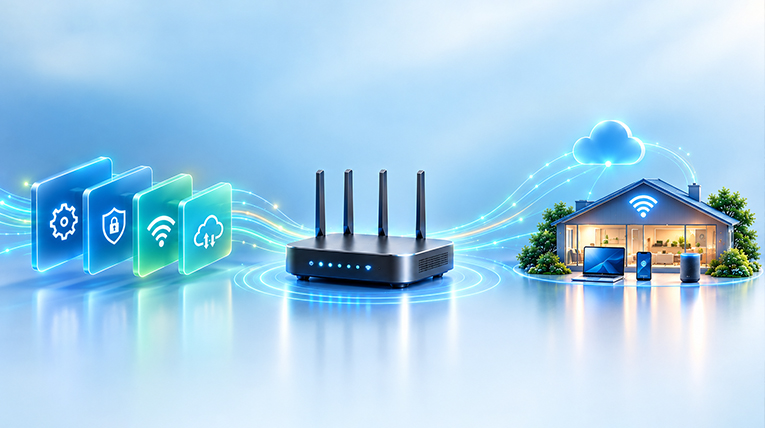
Open source provides the foundation. Engineering turns it into a differentiated broadband platform.
The broadband gateway is no longer just a box that routes traffic. It has evolved into a software-defined connectivity platform that brings together high-speed networking, Wi-Fi, security, remote management, diagnostics and connected-home services.
For OEMs, ISPs and telecom operators, the challenge is building a platform that can adapt to changing silicon, hardware architectures, network requirements and service requirements without rebuilding the entire software stack for every product.
This is where prplOS provides a strong foundation.
Based on OpenWrt, prplOS provides a modular software platform for embedded networking devices, with an architecture designed to support hardware abstraction, standardized interfaces and application extensibility. The broader prpl ecosystem extends this foundation with technologies and components for device management, application deployment and managed connectivity.
However, adopting prplOS is only the starting point. The real engineering value lies in adapting, integrating and extending prplOS to meet specific silicon, hardware, network, operator and product requirements.
Table of Contents
From SoC Integration to a Functional Platform
Every broadband product starts with a hardware platform. The target SoC, Ethernet interfaces, Wi-Fi subsystem, memory, storage and other peripherals must be properly enabled and integrated into the software stack.
This typically involves integrating the SoC vendor’s SDK, BSP components, device drivers, firmware and hardware-acceleration capabilities with the prplOS architecture. The level of integration can vary depending on the SoC, board design, vendor SDK and product requirements.
The objective is not simply to get the operating system to boot. The underlying hardware capabilities must be exposed reliably to higher-level software layers while preserving performance, hardware acceleration, stability, resource utilization and overall product functionality.
This includes validating critical Ethernet and Wi-Fi data paths, integrating platform-specific drivers and firmware and establishing the interfaces required by higher-level networking and management components.
Depending on product and business requirements, OEMs may choose different integration approaches, from a standard prplOS implementation to a hybrid architecture where proprietary or platform-specific components coexist with the broader open-source framework. This creates a hardware-ready software platform that can serve as the foundation for further broadband functionality and customization.
Building the Broadband Experience
Once the underlying hardware platform is enabled, the next step is to build the functionality expected from a modern broadband gateway.
This may include:
- WAN and LAN Connectivity
- Ethernet Interfaces and Switching
- Routing, NAT and Forwarding
- IPv4 and IPv6
- DHCP and DNS
- Firewall and Network Security
- QoS and Traffic Management
- Wi-Fi Configuration and Management
- Diagnostics, Monitoring and Telemetry
- Software Lifecycle and OTA Firmware Management
- Remote Device and Service Management
The challenge is not simply implementing individual functions. These functions need to be integrated without creating a tightly coupled software stack.
A modular architecture helps isolate functionality behind well-defined interfaces, allowing components to be upgraded, replaced, or extended without major changes across the platform.
This becomes increasingly valuable as products evolve across different SoCs, hardware revisions, Wi-Fi generations, operator requirements and software releases.
For OEMs, this provides greater flexibility to customize the platform around their product roadmap rather than being constrained by a fixed software implementation.
Standardizing Device Management with TR-181
A modern broadband gateway needs a consistent way to represent its capabilities, configuration, operational state and statistics.
This is where TR-181 plays an important role.TR-181 defines a standardized device data model for broadband and connected devices. Its Device: 2 model covers areas such as device information, network interfaces, routing and bridging, software, performance statistics, diagnostics and other device capabilities.
The data model can be used with management technologies such as TR-069 and USP, providing a consistent structure through which management systems can access and control device parameters.
For product developers, this provides a common foundation across different hardware platforms, product generations and operator environments.The result is a more consistent foundation for device management, diagnostics, telemetry, automation and service integration.
Implementing the data model, however, requires the underlying platform components to correctly expose, update and maintain the corresponding TR-181 parameters throughout the device lifecycle.
Extending the Gateway to Managed Wi-Fi
As operators deploy multiple access points, repeaters and extenders, delivering a consistent Wi-Fi experience requires more than managing each device independently.
This is where prplMesh becomes relevant. PrplMesh is an open-source implementation of the Wi-Fi Alliance EasyMesh architecture, providing functionality for Controller and Agent roles in multi-AP Wi-Fi deployments.
When integrated with a prplOS-based platform, prplMesh can provide the foundation for coordinated whole-home Wi-Fi, allowing multiple access points and extenders to operate as part of a managed multi-AP network. This can include capabilities such as network topology management, device onboarding, configuration, monitoring and mechanisms supporting client and network optimization across multiple access points.
For OEMs and operators, the opportunity goes beyond extending Wi-Fi coverage. It enables a managed connectivity layer across gateways, access points and extenders, while retaining flexibility for operator-specific policies, services, analytics and user experiences.
Connecting the CPE to the Cloud with TR-369 / USP
A broadband product does not end when it leaves the factory. Once deployed, operators need to configure, monitor, diagnose, update and manage devices throughout their lifecycle.
This is where TR-369 / User Services Platform (USP) becomes important. USP provides a standardized framework for managing and monitoring connected devices and services. It works with device data models such as TR-181, allowing management systems to interact with standardized representations of device configuration, state, capabilities, statistics and services.
This can enable:
- Remote Configuration and Provisioning
- Device Monitoring and Status Collection
- Diagnostics and Troubleshooting
- Software and Firmware Management
- Service Configuration and Lifecycle Management
- Event and Notification Handling
- Operational Visibility Across Deployed Devices
Together, TR-181 and TR-369/USP provide a standardized management foundation. Engineering is required to integrate these capabilities with the device software and operator backend systems reliably.
From Firmware to an Extensible Platform
The next step is enabling the gateway to support new services beyond the functionality delivered in its original firmware release. The prpl ecosystem includes prplLCM, which provides mechanisms to manage the lifecycle of software components and applications, including containerized workloads.
This creates a foundation for deploying, updating, monitoring and managing additional software services without requiring the entire gateway firmware to be rebuilt for every new capability. Services such as security, analytics, diagnostics, parental controls and connected-home applications can evolve alongside the core networking stack.
For OEMs and operators, this creates a more flexible software platform where new services can be introduced and maintained throughout the product lifecycle. The gateway evolves from a fixed firmware appliance into a software platform capable of supporting new services throughout its lifecycle.
VVDN prplOS Development Services
At VVDN, we provide engineering services across the prplOS development lifecycle, helping OEMs, ISPs and telecom operators integrate, customize and extend prplOS-based broadband platforms around their product requirements.
Our capabilities span:
SoC & BSP Integration
Hardware enablement, device drivers, vendor SDK/BSP integration, firmware integration and hardware acceleration.
Broadband Platform Development
Networking, Ethernet, switching, routing, NAT, IPv4/IPv6, Wi-Fi, security, QoS, diagnostics and platform services.
Open APIs & Software Interfaces
Integration of appropriate high-level and low-level interfaces while maintaining separation between hardware-dependent and platform-independent components.
Managed Wi-Fi
Integration of prplMesh and EasyMesh capabilities for coordinated multi-AP deployments.
Device & Cloud Management
Integration of TR-181 data models and TR-369/USP-based device and service management.
Application Enablement
Integration and lifecycle management of additional software components and applications, including containerized workloads where applicable.
Validation & Certification
Functional, interoperability, performance, scalability, security and stability testing across hardware and software configurations.
VVDN:Engineering Broadband Platforms with prplOS
At VVDN, we help OEMs, ISPs and telecom operators turn the flexibility of prplOS into broadband platforms aligned with their product and service requirements.
By combining platform engineering, networking expertise, managed connectivity, cloud integration and validation, we help customers build software architectures that can adapt as hardware, network technologies and service requirements evolve.
The focus is not just on integrating an open-source operating system, but on creating a flexible and maintainable platform that gives product teams greater freedom to differentiate, scale across product variants and introduce new capabilities throughout the device lifecycle.
With experience across broadband, Wi-Fi, networking and embedded software, VVDN brings the engineering depth required to take prplOS from an open-source foundation to a platform tailored for real-world broadband products.