
 Global
 United States
  Japan
Japan 



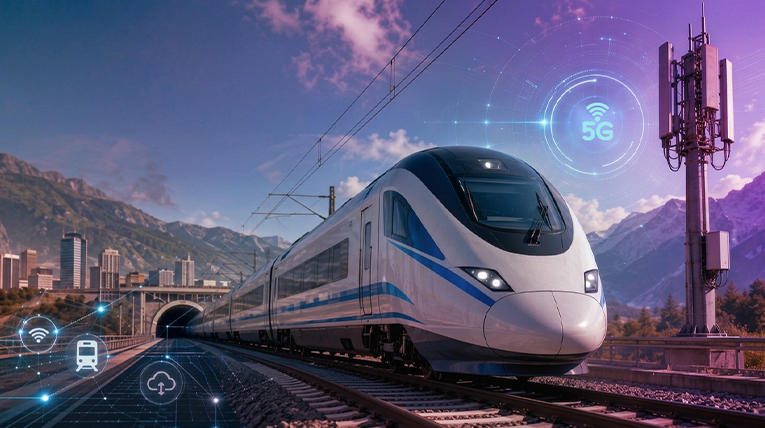
The global railway industry is entering a major communications transformation. As legacy GSM-R networks approach end-of-life, the industry is migrating to FRMCS (Future Railway Mobile Communication System), the 5G-based communication standard being developed by the UIC in coordination with 3GPP and ETSI’s Technical Committee for Rail Telecommunications (TC-RT), under the oversight of the European Union Agency for Railways (ERA).
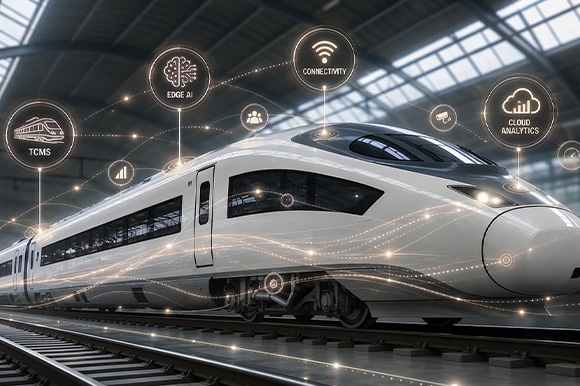
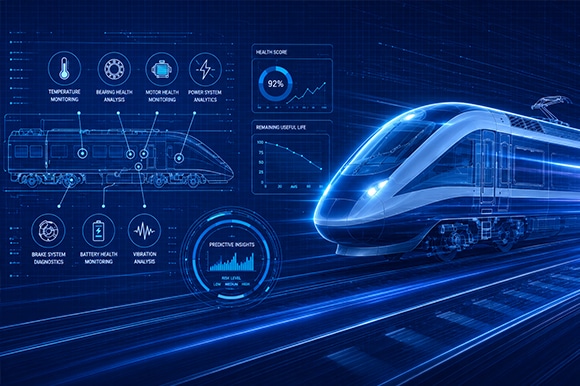
FRMCS is not simply a telecom upgrade. It is the next-generation mission-critical communication backbone for digital railways, enabling advanced ETCS signaling, automated train operations, real-time diagnostics, trackside video analytics, predictive maintenance and railway IoT applications.
The FRMCS ecosystem has already defined the reference architecture, spectrum framework and mission-critical application layers. The real challenge begins when those standards have to run reliably on a train moving through tunnels, extreme climates, dense urban corridors and remote rail infrastructure.
The bottleneck in FRMCS deployment today is no longer the network architecture, it is the execution: railway-grade hardware, ruggedization, interoperability validation and manufacturing at scale.
For rolling stock communication suppliers, railway system integrators and FRMCS infrastructure providers, deployment speed now depends on finding engineering partners who can turn telecom-grade 5G technology into railway-certified, field-proven systems.
Table of Contents
1. The Complex Reality of On-Board and Trackside FRMCS Hardware
Migrating from narrowband GSM-R to broadband 5G FRMCS is a fundamental leap in hardware complexity. Modern railway communication systems now have to integrate:
- On-board units (OBU) and cab radios
- Wayside/trackside distributed radio systems
- Mission-critical edge compute platforms
- Massive MIMO-based radio units
- Railway-certified RF front-end architectures
- High-performance backhaul and fronthaul links
- Rugged, heavy-duty 5G protocol stack support built to sustain continuous mission-critical throughput under vibration, thermal and EMC stress
- Modular radio and compute units built on open interfaces, so different vendors’ modules can interoperate on the same platform
Unlike enterprise or general telecom deployments, this hardware has to keep operating under conditions most 5G equipment never sees:
- Continuous vibration and mechanical shock
- Wide temperature swings
- Electromagnetic interference from traction systems
- Dust, humidity and ingress exposure
- Long service life and high MTBF requirements
- Strict EN railway compliance standards
This is where taking a telecom vendor’s reference design and turning it into a manufacturable, railway-certified platform gets hard. It takes deep expertise in ruggedized electronics design, railway-grade PCBA engineering, thermal management, RF shielding and EMC compliance, mechanical enclosure design and environmental qualification.
A rugged 5G stack is as much a reliability requirement here as the enclosure around it, the protocol stack itself has to keep mission-critical sessions stable through handovers, interference and thermal drift, not just survive them mechanically.
For FRMCS, hardware reliability isn’t just a performance metric – it’s directly tied to operational safety and network availability.
2. Interoperability, Simulation and Compliance Validation
FRMCS equipment can’t be validated inside a conventional telecom test environment alone. Before it goes anywhere near rolling stock or a live corridor, it has to clear interoperability, mobility and environmental validation aligned to real railway operating conditions, including:
- High-speed mobility scenarios above 300 km/h
- Doppler-effect impact on radio performance
- Seamless handovers across linear railway corridors
- Multi-cell mobility optimization
- Tunnel-to-open-track transition behavior
- ETCS and signaling communication continuity
- Fail-safe redundancy mechanisms
- Deterministic latency performance
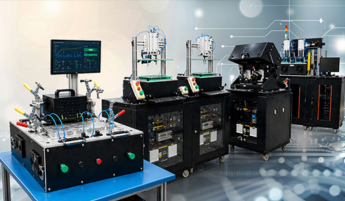
Reproducing this reliably requires Hardware-in-the-Loop (HIL)/Software-in-the-Loop (SIL) rigs and railway network emulation frameworks built to mirror real-world railway RF behavior, not just lab conditions.
Open, standards-based interfaces between the radio, compute and application layers are what make this kind of validation possible at scale. They let OEMs, integrators and infrastructure providers test and certify interoperable modules independently, rather than being locked into a single vendor’s closed stack – which is central to FRMCS’s multi-vendor ambitions.
Alongside that, the hardware itself has to clear environmental and compliance testing against standards such as EN 50155 (rolling stock electronics), EN 50121 (EMC) and IEC 61373 (shock and vibration), with EN 45545 (fire safety) governing material and enclosure choices. That means validation labs capable of thermal cycling, vibration analysis, EMC testing, ingress-protection verification and shock testing become a prerequisite for certification readiness.
3. Security by Design: Authentication, Ciphering and Trust
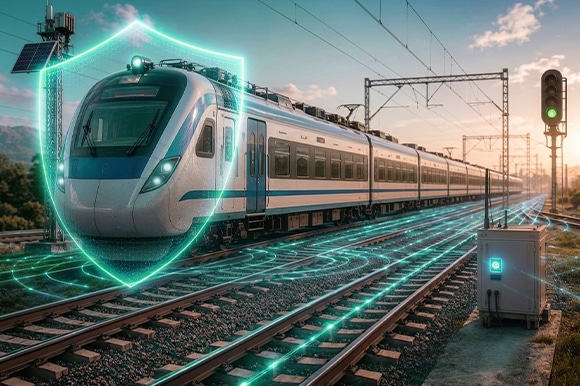
FRMCS carries safety-critical signaling and control traffic, so security can’t be layered on after the fact – it has to be engineered into the hardware and firmware from the start. Building on the 3GPP mission-critical services framework, FRMCS deployments need:
- SIM/USIM-based mutual authentication for every on-board unit and trackside device before it is allowed onto the network
- End-to-end ciphering and integrity protection for voice, video and mission-critical push-to-talk data
- Secure key management and credential provisioning across the mission-critical core
- Hardware-backed secure elements to protect keys and certificates from tampering
- Resilience against jamming, spoofing and denial-of-service attempts on safety-critical links
Getting this right at the hardware level is what lets FRMCS networks meet the trust and safety assurances that ETCS and other signaling systems are built on.
4. Engineering Lessons from Tactical and Mission-Critical Networks
FRMCS networks have a lot in common with tactical communication systems and mission-critical private 5G deployments. Both demand ultra-high reliability, secure communication links, resilient availability, low-latency data transfer, ruggedized hardware and power-efficient edge infrastructure.
Engineering disciplines built for tactical communications, defense-grade networking equipment and private 5G in harsh environments carry over directly into FRMCS: anti-interference RF design, rugged compute engineering, secure communication hardware, edge AI processing, outdoor telecom enclosure design and high-availability network architectures. These are exactly the capabilities that keep railway operations and passengers – safe when the network can’t afford to drop.
5. Accelerating the FRMCS Future with VVDN
At VVDN, we see successful FRMCS deployment as fundamentally an engineering execution challenge, spanning hardware design, interoperability validation, ruggedization, security and scalable manufacturing.
We don’t compete with railway communication OEMs, signaling providers, or FRMCS infrastructure vendors – we enable them. From electronics design and railway-grade PCBA development to RF engineering, ruggedized system design, open-interface module architectures, SIM-based security integration, validation infrastructure and high-volume manufacturing, VVDN operates as a strategic engineering and manufacturing partner for next-generation railway communication systems.
Our experience across telecom, private 5G, edge infrastructure and mission-critical networking lets us bridge the gap between FRMCS standards on paper and field-proven railway deployment, turning complex 5G railway architectures into scalable, certifiable and secure hardware platforms.
For more information, explore our railways offering page https://www.vvdntech.com/railways or can also get in touch with us at info@vvdntech.com.