
 Global
 United States
  Japan
Japan 



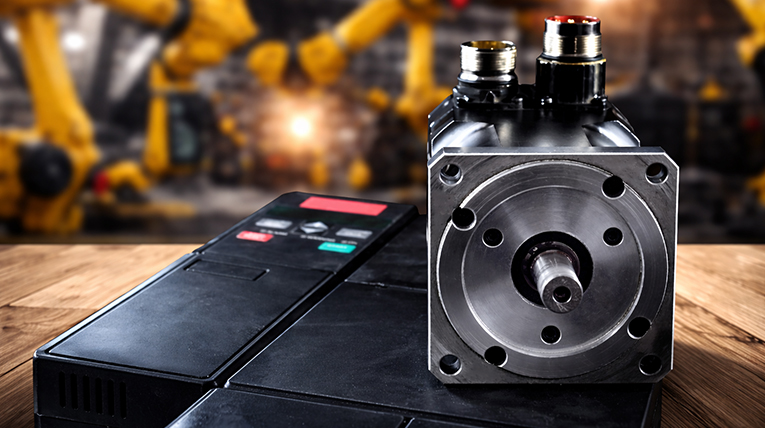
Modern factory automation is undergoing a rapid transformation, driven by the demand for higher precision, faster throughput, and improved reliability. At the core of this evolution lies servo motor control—a critical technology enabling accurate positioning, synchronized motion and repeatable performance across complex industrial systems.
From high-speed pick-and-place machines to precision assembly lines, servo systems are the backbone of motion control. However, designing an efficient servo control system is not just about selecting the right motor—it requires a well-thought-out architecture that balances real-time execution with system intelligence.
Table of Contents
Understanding Servo Motor Control
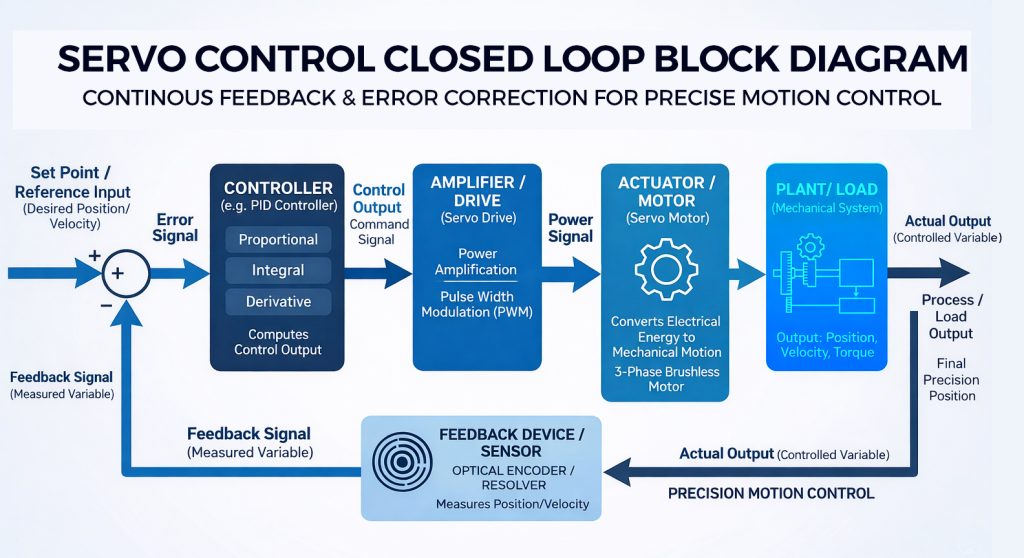
A servo motor system is a closed-loop control system that continuously monitors and adjusts its operation based on feedback.
Key components include:
- Servo Motor
- Feedback Device (Encoder/Resolver)
- Servo Drive (Controller)
Unlike conventional motors, servo systems:
- Continuously correct their position
- Maintain high accuracy under varying loads
- Deliver precise control over position, speed and torque
In factory automation, even the smallest deviation can lead to defects—making precision non-negotiable.
Key Requirements in Factory Automation
Servo motor control systems in industrial environments must meet strict performance criteria:
- Deterministic real-time control
- Ultra-low latency response
- High repeatability and accuracy
- Multi-axis synchronization
- Robust industrial communication support
Even microsecond-level delays or jitter in control signals can directly impact product quality and throughput.
Challenges in Servo Control Systems
As automation systems become more advanced, several challenges emerge:
1. Real-Time Determinism
Maintaining consistent timing is critical. Non-deterministic systems can introduce jitter, affecting motion precision.
2. Multi-Axis Coordination
Modern machines often require tightly synchronized movement across multiple axes, increasing system complexity.
3. Integration with Intelligence Layers
With the rise of AI and vision-based systems, integrating motion control with high-level processing becomes challenging.
4. System Scalability
Scaling from a single-axis setup to multi-axis industrial systems requires robust and flexible architectures.
The real challenge lies in bridging the gap between high-level intelligence and real-time motion execution.
Servo Control Architectures
Choosing the right architecture is crucial for achieving performance, scalability and reliability.
1. Traditional Servo Drive-Based Architecture
Controller → Industrial Network → Servo Drive → Servo Motor
Key Benefits:
- High precision and reliability
- Widely adopted in industrial environments
- Supports multi-axis scalability
In this setup, the controller sends commands over industrial networks such as EtherCAT or CANopen, while the servo drive handles real-time motor control.
2. Layered Control Architecture (High-Level + Real-Time)
High-Level Controller → Real-Time Controller → Motor Drive → Servo Motor
Key Benefits:
- Separation of responsibilities
- High-level controller handles:
- Motion planning
- User interface
- Data processing
- Real-time controller ensures deterministic execution
This layered approach enables both intelligence and precision, making it ideal for advanced automation systems.
3. Intelligent Automation Architecture
Processing Unit → Vision/AI → Motion Planning → Servo Drives → Servo Motors
Key Benefits:
- Enables adaptive and smart systems
- Supports real-time decision-making
- Ideal for Industry 4.0 environments
This architecture is increasingly used in systems where machines must “see, think, and act” in real time.
Real-World Applications
Servo motor control is widely used across factory automation:
- Pick-and-place robotics
- Precision assembly lines
- Packaging and labeling machines
- Camera alignment and inspection systems
- CNC and machining centers
In high-speed applications, servo systems ensure accurate positioning with minimal cycle time—directly impacting productivity.
Best Practices for Designing Servo Systems
To build reliable and scalable servo control systems:
Use Dedicated Real-Time Controllers
Avoid relying solely on non-real-time processing units for motion execution.
Separate Intelligence from Execution
Keep motion planning and AI workloads separate from real-time control loops.
Choose the Right Communication Protocol
Protocols like EtherCAT, PROFINET, or CANopen ensure deterministic communication.
Focus on Feedback Accuracy
High-quality encoders and feedback systems are critical for precision.
Design for Scalability
Ensure the system can handle multi-axis expansion without performance degradation.
Future Trends in Servo Motor Control
Factory automation is evolving toward smarter and more connected systems:
- AI-driven motion control
- Predictive maintenance using data analytics
- Time-Sensitive Networking (TSN) for deterministic communication
- Edge intelligence for real-time decision-making
The future lies in seamlessly integrating motion control with intelligent, connected systems.
Conclusion
Servo motor control remains the backbone of modern factory automation. However, achieving high precision and scalability requires more than just selecting the right components—it demands a carefully designed system architecture that balances real-time execution with intelligent control.
As industries move toward smarter factories, the convergence of motion control, AI and connectivity will define the next generation of automation systems.
Enabling Next-Gen Automation with VVDN
Building such advanced automation systems requires deep expertise across hardware, software and system integration.
VVDN Technologies offers end-to-end capabilities, including:
- Embedded hardware design
- Real-time software and BSP development
- Industrial communication integration
- Vision systems and AI enablement
- Manufacturing and large-scale deployment
For applications that demand both high-performance processing and industrial-grade reliability, platforms like the NXP i.MX 94 SoM—engineered and supported by VVDN—can serve as a powerful foundation for intelligent automation systems.
Whether you’re building next-generation robotics, smart inspection systems or scalable factory automation platforms, VVDN can help accelerate your journey from concept to deployment.