
 Global
 United States
  Japan
Japan 


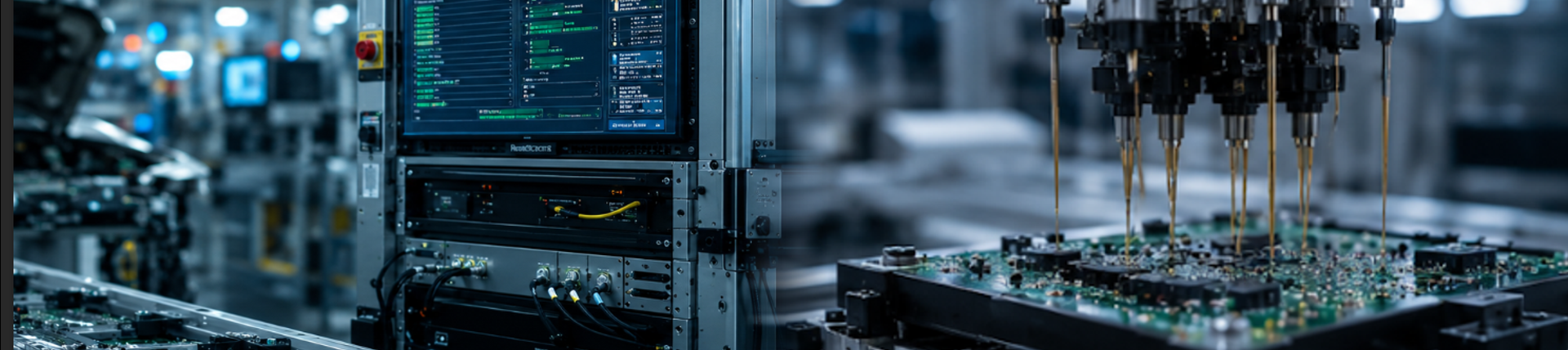
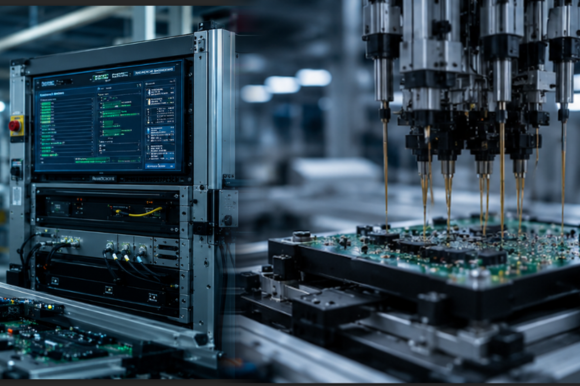
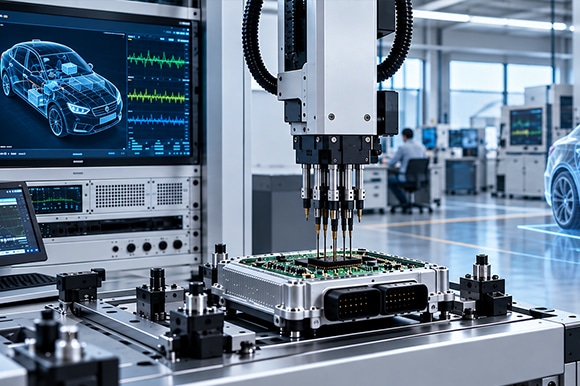
EV platforms, ADAS electronics, connected vehicle architectures, and software-defined systems are fundamentally changing how automotive products are validated on the factory floor. Production environments that once relied on isolated inspection stages now require continuous, data-driven quality verification across the entire manufacturing lifecycle.
Advanced validation platforms help automotive OEMs and production teams:
• Improve first-pass yield across high-volume production lines
• Reduce false failures and unnecessary rework cycles
• Accelerate root cause analysis through real-time analytics
• Improve traceability across battery, PCB, and semiconductor workflows
• Minimize production bottlenecks caused by manual inspection stages
• Support EV and ADAS manufacturing environments
• Enable predictive quality monitoring using AI and Physical AI-driven analytics
This is particularly important across battery validation, semiconductor manufacturing, automotive PCB testing, and vision-based end-of-line inspection environments where production complexity and validation requirements continue to grow.
Table of Contents
Why EV Production Is Reshaping Automotive Quality Validation
Traditional automotive testing infrastructure was designed for mechanically dominated vehicle architectures with relatively simpler electronics integration and lower software dependency. EV production environments operate under completely different conditions.
Today’s vehicles require simultaneous validation of electrical performance, firmware communication, thermal behavior, calibration accuracy, high-voltage safety, and communication integrity across multiple manufacturing stages. At the same time, automotive production teams are under pressure to accelerate throughput while maintaining strict reliability standards.
Legacy testing models that depend heavily on isolated final inspection stages often struggle with delayed defect visibility, longer troubleshooting cycles, increased rework costs, and production bottlenecks. This becomes increasingly challenging as battery systems, ADAS electronics, and semiconductor technologies continue expanding validation requirements across production environments.
Another major challenge is testing throughput. As battery architectures, embedded software layers, and communication interfaces become more complex, validation cycle times continue increasing across automotive assembly lines. Automotive OEMs are therefore shifting toward distributed inspection models that combine process-stage verification, machine vision systems, and AI-enabled ATE platforms to reduce downstream bottlenecks while improving traceability and first-pass yield.
In-Line Testing in Modern Vehicle Electronics and EV Production
To manage rising electronics complexity and tighter production tolerances, production teams are increasingly distributing quality verification across multiple stages of the production workflow rather than relying solely on final inspection.
In-line testing refers to validation processes embedded directly within the production line during assembly stages. Instead of testing products only after final assembly, quality is continuously monitored as products move through different manufacturing operations.
This approach is widely used across PCB assembly lines, semiconductor packaging environments, ECU production, sensor integration workflows, and battery management system manufacturing. The objective is early defect containment before faulty assemblies move into higher-value integration stages.
Advanced semiconductor manufacturing environments rely heavily on technologies such as Automated Optical Inspection (AOI), In-Circuit Testing (ICT), machine vision inspection, and automated probing platforms. These systems help identify soldering inconsistencies, component placement errors, electrical faults, connector defects, and signal integrity issues in real time.
For high-volume vehicle electronics production, embedded inspection layers have become essential because assembly density and system complexity continue increasing with every vehicle generation.
End-of-Line Testing for EV and Automotive Systems
End-of-line testing is performed after the product is fully assembled and manufacturing processes are completed. Unlike process-stage inspection, final-stage validation focuses on confirming whether the product performs according to operational and functional requirements under simulated real-world conditions.
End-of-line testing equipment is widely used on automotive production lines to validate EV battery packs, infotainment systems, powertrain electronics, ADAS modules, radar platforms, and electronic control units.
These validation systems verify electrical behavior, firmware interaction, CAN/LIN communication, thermal performance, calibration accuracy, and functional reliability before products move toward vehicle integration or shipment.
In EV production environments, battery pack end-of-line testing equipment plays an especially critical role due to the complexity of high-voltage architectures. Production teams must validate insulation resistance, voltage balancing, charging behavior, thermal stability, and battery management system communication within extremely tight production timelines.
Final-stage verification has become a critical control layer because many software, thermal, communication, and power-management failures only emerge once the complete system operates under simulated real-world conditions.
In-Line Testing vs End-of-Line Testing
| Parameter | In Line Testing | End-of-Line Testing | Intelligent ATE Ecosystem |
| Validation Stage | During the production flow | After final assembly | Connected across the entire production lifecycle |
| Primary Objective | Early defect containment | Functional and operational verification | Predictive quality optimization |
| Focus Area | Process consistency | Product-level performance | Production intelligence and traceability |
| Common Technologies | AOI, ICT, SPI, vision systems | Functional validation, load simulation | AI analytics, MES integration, smart automation |
| Operational Impact | Reduces rework and scrap | Prevents field failures | Improves throughput and yield optimization |
| Scalability | Effective for process monitoring | Can become bottlenecks in legacy setups | Designed for high-volume EV production |
| Data Capability | Limited process feedback | Final product validation | Real-time analytics and defect correlation |
How Intelligent Automated Test Equipment (ATE) Is Transforming Smart Manufacturing
Connected production environments increasingly depend on validation infrastructure capable of operating as part of a broader smart manufacturing ecosystem rather than functioning as standalone inspection stations.
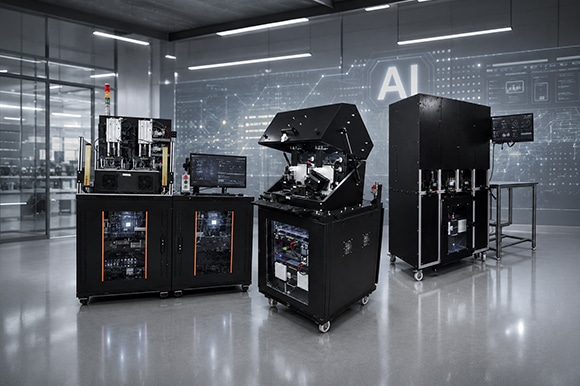
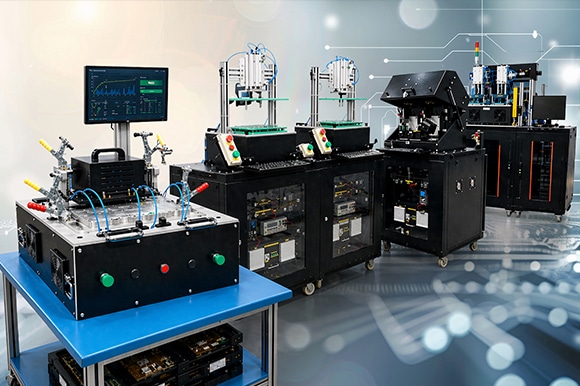
Traditional ATE platforms primarily focused on pass/fail verification. New-generation systems are evolving into integrated production intelligence platforms that combine functional testing, machine-vision inspection, predictive analytics, manufacturing traceability, and MES/ERP integration into a unified workflow.
This transition is becoming essential as vehicle electronics, software-driven functionality, and connected mobility architectures continue to increase testing requirements across production environments. These advanced vehicle systems generate large volumes of production and testing data that cannot be efficiently managed through isolated inspection environments.
AI-powered ATE platforms help automotive organisations improve first-pass yield, accelerate root cause analysis, reduce false failures, and optimise production throughput. They also reduce dependency on manual inspection workflows that frequently slow down scaling efforts in high-volume production environments.
As automotive production continues shifting toward connected mobility systems and autonomous vehicle architectures, validation infrastructure is evolving from isolated quality checkpoints into connected manufacturing ecosystems.
AI in Automotive Testing and Validation
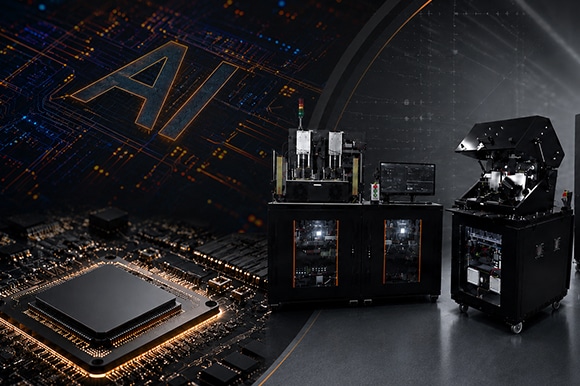
Artificial Intelligence is transforming automotive testing into a predictive and data-driven validation process. As EV platforms, ADAS systems, automotive PCBs, and software-defined vehicles become more complex, organizations are integrating AI with AI-enabled ATE systems, machine vision platforms, and end-of-line testing infrastructure to improve quality, testing accuracy, and production efficiency.
AI-powered automotive test systems help organizations detect defects earlier, reduce false failures, improve root cause analysis, and strengthen traceability across automotive electronics manufacturing workflows. In EV production environments, AI-driven analytics also improve battery pack validation, thermal monitoring, and communication testing within advanced end-of-line testing systems.
Benefits of AI-Powered ATE Systems in Automotive Validation
| AI Testing Capability | Manufacturing Impact |
| Adaptive Test Simulation | Simulates real-world driving, sensor, and environmental conditions for better ECU and ADAS validation |
| Edge Case Detection | Identifies rare faults and abnormal operating scenarios missed by traditional testing |
| Faster Root Cause Analysis | Quickly analyzes testing data to accelerate defect identification and troubleshooting |
| Smarter Vision Inspection | Improves defect detection, connector verification, and cosmetic inspection accuracy |
| Predictive Quality Monitoring | Detects process drift and potential equipment failures before production impact |
| Enhanced EV Battery Validation | Improves detection of thermal, charging, and voltage balancing issues |
| Reduced Rework and False Failures | Minimizes unnecessary rejection cycles and improves first-pass yield |
| Better Traceability and Compliance | Supports production traceability and automotive quality standards |
| Smart Manufacturing Integration | Connects with MES and Industry 4.0 systems for scalable production optimization |
| Physical AI-Driven Validation | Enables autonomous inspection, adaptive testing workflows, robotic quality verification, and real-time production optimization |
Growing Importance of AIO/Vision Inspection and ICT in Automotive Electronics
Vision inspection for end-of-line products has become increasingly important as automotive electronics and assembly complexity continue rising. Machine vision systems are now widely used for connector verification, weld inspection, barcode traceability, cosmetic validation, dimensional inspection, and assembly confirmation.
At the same time, in-circuit tester manufacturers continue playing a foundational role in PCB validation workflows. ICT systems help identify open circuits, short circuits, incorrect component placement, and assembly-level electrical defects before assemblies progress to higher-value manufacturing stages.
As automotive PCBs become denser and more functionally complex, ICT and machine vision technologies are becoming essential components within next-generation automotive quality ecosystems.
Why Choose VVDN Technologies for Automotive Test Automation
VVDN Technologies helps automotive OEMs and Tier-1 suppliers modernise production validation infrastructure through connected ATE platforms, machine vision integration, inline quality verification, and scalable end-of-line testing solutions.
VVDN’s capabilities span EV battery validation, PCB and electronics testing, semiconductor-focused inspection workflows, smart manufacturing automation, and Industry 4.0 integration designed for high-volume production environments.
By combining advanced validation infrastructure with manufacturing automation expertise, VVDN helps automotive organisations improve production scalability, strengthen traceability, reduce quality escape risks, and optimise operational efficiency across advanced automotive and EV production ecosystems.
To discuss your automotive manufacturing automation or ATE requirements, contact the VVDN team at: info@vvdntech.com.