Global
 United States
  Japan
Japan 



Table of Contents
Overview
Imagine a network that doesn’t just follow rules but actually thinks for itself. A network that learns from past traffic patterns, predicts congestion and adapts in real time, all without manual intervention. That’s exactly what AI-enhanced SD-WAN brings to the table. For years, businesses relied on Multiprotocol Label Switching for connectivity. While it provided reliable performance, it came with high costs, slow scalability and rigid infrastructure. Then, Software-Defined Wide Area Networking transformed enterprise networking by intelligently managing traffic across broadband, LTE, and 5G, optimizing costs and flexibility. However, even traditional SD-WAN has its challenges; it still requires manual configurations, predefined policies and human intervention to maintain performance and security.
Now, the next evolution is here, AI-enhanced SD-WAN, which takes the core benefits of SD-WAN and supercharges them with Artificial Intelligence (AI) and Machine Learning (ML) to deliver self-optimizing, self-healing and self-securing networks.
AI-enhanced SD-WAN: The Future of Intelligent, Secure Networking
As enterprises scale their operations across Cloud environments, remote workforces and IoT-driven ecosystems, traditional SD-WAN faces limitations in managing performance, security and automation. Enter AI-enabled SD-WAN, a transformative approach that integrates intelligence, automation and adaptive security to optimize networking like never before.
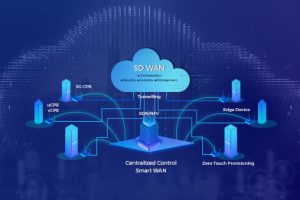
A truly AI-enhanced SD-WAN enhances three critical network planes to create a seamless, secure, and self-optimizing infrastructure:
- Management Plane – Automation & Simplified Operations
Traditional SD-WAN requires manual configurations, monitoring and troubleshooting – often resulting in operational inefficiencies. AI automates network provisioning, anomaly detection and performance tuning, reducing IT workload and enabling zero-touch deployments. AI-powered insights also provide predictive analytics, helping businesses optimize their network resources proactively.
- Control Plane – Smarter Traffic Management
AI enhances decision-making in the control plane by dynamically adjusting traffic routing, load balancing and application prioritization based on real-time network conditions. Instead of relying on static policies, AI predicts congestion, latency spikes and link failures, proactively rerouting traffic to ensure the best user experience.
- Data Plane – Enhanced Performance & Self-Healing
The data plane, responsible for packet forwarding and traffic handling, becomes self-optimizing with AI. It continuously analyzes network behavior, detects anomalies and applies real-time optimizations to reduce jitter, minimize packet loss and improve overall throughput. AI-driven self-healing mechanisms allow networks to recover from failures without manual intervention.
AI-enhanced Zero Trust: A New Era of SD-WAN Security
Security remains a critical concern in modern SD-WAN deployments. AI-driven SD-WAN integrates Zero Trust Network Access (ZTNA) principles, ensuring that every connection is verified, encrypted and continuously monitored. Here’s how AI strengthens security:
- Automated Threat Detection & Response: AI continuously analyzes network traffic for anomalies, malware and potential intrusions, blocking threats before they spread.
- Behavior-Based Security: Instead of relying on static security rules, AI learns user and device behaviors, flagging suspicious deviations in real-time.
- End-to-End Encryption: AI optimizes security policies dynamically, ensuring that every data packet is protected from unauthorized access.
- Identity-Based Access Controls: AI ensures that only authenticated users and devices can access critical network resources, preventing lateral movement of threats.
Limitations of Traditional SD-WAN & How AI Transforms It
- Rigid Traffic Routing – AI Enables Smart, Real-Time Path Selection
Traditional SD-WAN routes traffic based on predefined rules. If a policy prioritizes MPLS over broadband, it will continue using MPLS – even if broadband is faster and more stable at that moment. AI-driven SD-WAN analyzes real-time conditions and dynamically selects the best path, ensuring uninterrupted connectivity for critical applications like video conferencing and cloud services.
- Reactive Troubleshooting – AI Predicts & Prevents Network Issues
Without AI, IT teams must manually diagnose and fix problems – often after users experience downtime. AI-enhanced SD-WAN, however, predicts failures before they occur. It detects early warning signs of network congestion, hardware degradation, or link instability and takes proactive actions, such as rerouting traffic or triggering automated fixes.
- Static Security Policies – AI Learns & Adapts to New Threats
Traditional SD-WAN security relies on fixed policies that must be updated manually. This leaves networks vulnerable to zero-day attacks and unknown threats. AI-driven SD-WAN monitors traffic behavior in real-time, detects anomalies and instantly blocks suspicious activity offering self-learning, adaptive cybersecurity without human intervention.
- Manual Bandwidth Allocation – AI Optimizes Resources Dynamically
SD-WAN without AI distributes bandwidth based on static settings, leading to wasted resources in low-usage areas and congestion in high-traffic locations. AI continuously learns from usage patterns and automatically adjusts bandwidth allocation to meet actual demand improving performance while reducing costs.
- Complicated Configurations – AI Automates Network Management
Setting up and managing SD-WAN requires IT expertise, from defining policies to troubleshooting performance issues. AI-enhanced SD-WAN simplifies operations with self-learning automation, allowing businesses to deploy new branches instantly, optimize QoS settings dynamically and enforce security policies automatically.
SUMMARY
AI-enhanced SD-WAN isn’t just about improving network performance, it makes networks smarter, faster and more secure. It continuously analyzes traffic patterns, predicts potential issues and dynamically optimizes network performance. With built-in AI security, it detects and mitigates threats in real time, enhancing overall network protection. It also reduces manual work by automating bandwidth, policies and troubleshooting. As businesses grow and rely more on the cloud, AI-enhanced SD-WAN ensures seamless, cost-effective and secure connectivity making it the future of networking.
VVDN’s Expertise in SD-WAN Solutions for OEMs & ISVs
VVDN offers end-to-end engineering capabilities to help OEMs and ISVs build reliable and scalable SD-WAN CPE based on Intel Atom® x7000 processor series from early design to mass production. With deep expertise in uCPE hardware design, multi-WAN routing, LTE/5G integration, Wi-Fi, Ethernet, SFP interfaces, security frameworks and OS customization, VVDN enables customers to bring feature-rich SD-WAN appliances to market efficiently. VVDN also supports the integration of AI-driven analytics, policy automation and traffic optimization frameworks, enabling customers to enhance their SD-WAN solutions with emerging AI capabilities.
Our integrated approach covers hardware development, software enablement, cloud-native orchestration support, validation and high-volume manufacturing, helping customers reduce time-to-market and deliver stable, secure and cost-optimized SD-WAN solutions at scale.