

 Global

 United States
 Japan



For decades, India’s aerospace and defence engineering ran on borrowed schematics. Licensed production lines, transferred designs and imported subsystems gave the country manufacturing capacity however the intellectual property underneath, the architecture decisions, the firmware, the RF chains, stayed elsewhere. That layer is now shifting onshore and it’s a fundamentally different engineering challenge than scaling up a production line. Manufacturing excellence proved India could build reliably to someone else’s specification. What’s being tested now is whether it can originate from the specification itself and increasingly, the answer is yes.
Table of Contents
A Global Landscape in Flux
This shift isn’t happening in isolation, it’s riding a much bigger realignment in global aerospace and defence engineering. Supply chains that were optimised for decades around a handful of Western and a few Asian design-and-manufacturing hubs are being actively re-architected, as nations reassess the risk of depending on a single source for mission-critical electronics, RF components and semiconductors. A shortage in one geography, an export restriction in another or a geopolitical flashpoint anywhere along a component’s journey can now stall a defence programme for months, a fragility that was tolerable when defence-electronics cycles ran on decade-long timelines and is far less tolerable today.
Conflicts of the last few years have compressed those timelines dramatically, turning what used to be decade-long technology-refresh cycles into eighteen-month iteration loops, particularly around autonomous systems, electronic warfare and AI-enabled sensing. Systems that once went through years of doctrine review before fielding are now being adapted, re-flashed and redeployed within a single operational season. That pace rewards organisations that own their own design stack because only a team that controls the architecture, the firmware, and the certification pathway can iterate that fast without waiting on an external vendor’s roadmap.
At the same time, the definition of “critical” defence IP has widened considerably. It’s no longer just airframes, hulls and munitions — it’s the compute architecture underneath a mission system, the deterministic networking backbone connecting sensors to shooters and increasingly, the AI models that sit on top of all of it, deciding what a sensor feed means and how fast a platform should react to it. A country that only manufactures the airframe but imports the compute, the network fabric and the intelligence layer hasn’t actually closed its strategic dependency – it’s just moved it one layer deeper.
That combination of supply-chain diversification, compressed innovation cycles and a broadened definition of strategic technology has opened a genuine window for countries with deep engineering talent pools but historically thinner design ownership. India sits squarely in that window and the programmes now maturing out of Indian design houses are the clearest evidence of it.
India’s Pivotal Role in Manufacturing and IP Creation
India’s position in this landscape is shifting from “trusted manufacturing base” to “credible design origin” and the two are not the same claim. A manufacturing base absorbs risk for its customers by building reliably to someone else’s specification, with quality and cost as the differentiators. A design origin absorbs a fundamentally different kind of risk – it takes ownership of the architecture, the certification pathway and the long-term sustainment of a system over its operational life, which is a much higher bar and a much stickier relationship once earned. Customers don’t just buy a design origin’s product; they inherit its engineering roadmap.
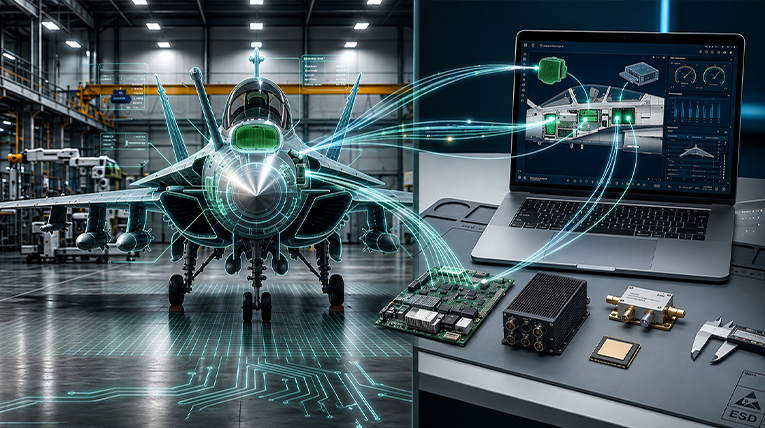
A handful of recent indigenous programmes illustrate what that bar looks like in practice. India’s Light Combat Aircraft programme has increasingly relied on systems engineered and qualified domestically rather than sourced whole from abroad – including, notably, an airworthy Time-Sensitive Networking (TSN) ethernet switch designed, developed and manufactured in India for the platform. TSN is the deterministic, IEEE 802.1-based networking backbone that modern avionics are moving toward, replacing legacy point-to-point wiring with a switched fabric that still guarantees the microsecond-level, zero-jitter timing that a mission computer, radar and flight-control system depend on – where a late packet isn’t a networking bug, it’s a flight-safety issue. Getting there means implementing traffic-shaping and time-synchronisation protocols in firmware with zero tolerance for drift, while the physical hardware is qualified against airworthiness standards for vibration, shock, thermal cycling, altitude and electromagnetic compatibility – an intersection of real-time embedded engineering and environmental certification that very few teams anywhere are equipped to close end to end.
Very few organisations anywhere in the world design and qualify airworthy TSN switches; it sits with a small set of specialised aerospace electronics houses globally. An Indian-origin, Indian-manufactured switch flying on a frontline indigenous fighter is a concrete marker of the shift this piece is describing – not assembly under license, but architecture, qualification and production owned end to end, domestically.
This is the pattern worth watching across the sector more broadly: naval combat-management and sonar processing increasingly designed in Indian houses, artillery fire-control and guidance electronics developed rather than licensed and a fast-growing base of MSMEs and startups – many incubated through iDEX – originating the kind of niche, high-reliability subsystems that used to be exclusively imported. None of it is achievable through manufacturing capacity alone; it takes systems engineering – architecture definition, FPGA and embedded design, RF and signal-chain engineering and rigorous verification against airworthiness and defence-electronics standards – done end to end by teams that own the design intent, not just the build.
Standards and Certification: The Invisible Engineering Bar
If there’s one part of this journey that gets the least public attention and deserves the most, it’s certification. A brilliant architecture on a whiteboard is not a fielded system – it’s a fielded system only after it has survived the standards regime that airworthiness and defence electronics demand: environmental qualification for temperature extremes, vibration and shock; electromagnetic compatibility so a system doesn’t interfere with or get disrupted by, everything else on the platform; and, for software and hardware in flight-critical paths, rigorous development-assurance processes that demand traceability from requirement to test case.
This is the part of indigenisation that’s hardest to shortcut. Manufacturing capacity can be built relatively quickly with capital and process discipline. A certification-ready engineering culture – the documentation rigor, the test infrastructure, the institutional muscle memory of what “airworthy” actually demands – takes years to build and is exactly why design ownership has historically concentrated in a small number of countries. Every indigenous programme that clears this bar isn’t just a product win; it’s evidence that the certification muscle itself now exists domestically, which is what makes the next programme faster and the one after that faster still.
Where AI Changes the Engineering Problem, Not Just the Feature List
The more interesting shift for engineers isn’t that AI is being “added” to defence systems – it’s that AI is changing what the hardware and software architecture has to do. A vision system on a surveillance platform or an autonomous vehicle isn’t running inference in a data centre; it’s running on a power and thermal-constrained edge processor, in a rugged enclosure, with degraded or contested connectivity and it has to make a correct decision in milliseconds.
That reframes several engineering disciplines at once:
- Compute Architecture: selecting and integrating edge AI accelerators (NPUs, GPUs, FPGAs) within tight SWaP (size, weight and power) budgets, rather than assuming cloud-scale compute is available.
- RF and Signal Processing: building adaptive chains that hold up under jamming and contested-spectrum conditions, where the “model” has to reason about signal integrity in real time.
- Autonomy Stacks: sensor fusion, real-time perception and decision logic that has to be deterministic and verifiable enough to pass mil-grade certification — a much harder bar than a typical commercial AI product.
- Ruggedization: taking all of the above and packaging it to survive vibration, temperature extremes and battlefield conditions without compromising the compute performance the AI workload needs.
- Networking and Timing: feeding AI inference pipelines with sensor data on the same kind of deterministic, low-jitter backbone that platforms use, because a perception model is only as reliable as the timing guarantees of the network delivering it data.
Recent conflicts have made the operational case for this concrete – low-cost, AI-guided autonomous systems have repeatedly outperformed far more expensive legacy platforms in real engagements. For engineering teams, the lesson isn’t “add AI” – it’s that the entire hardware-software co-design process now has to be built around the assumption that intelligence runs at the edge, not the core. For India, this is also where the pivotal-role argument gets stronger rather than weaker: a country with a deep bench of embedded, RF and systems engineers is well placed to own this edge-AI layer natively, rather than importing it as a black box bolted onto indigenous hardware.
Building the Design Culture, Not Just the Product
A single successful programme, however significant, doesn’t make an indigenisation story durable – a design culture does. That means academia and industry collaborating earlier in the engineering lifecycle rather than at the procurement stage, defence research labs sharing test infrastructure with private engineering houses instead of gatekeeping it and a growing base of startups and MSMEs – many incubated through iDEX and similar programmes – getting real exposure to airworthiness and defence-electronics standards early enough in their own product development that certification isn’t a bolt-on exercise at the end.
This is also a talent problem as much as a policy one. Systems engineers who can move fluidly between RF design, embedded firmware and certification documentation are still relatively scarce and building that bench – through hands-on programme experience rather than classroom theory alone – is arguably as strategically important as any single platform win. Every engineer who works through an airworthiness qualification cycle end to end takes that muscle memory into the next programme and the next company.
The Component and Semiconductor Question
Design ownership doesn’t yet mean full supply-chain sovereignty and it’s worth being honest about that gap. Even a domestically architected, domestically manufactured system still depends, in places, on globally sourced semiconductors, connectors and passive components – because the foundry and component ecosystem for defence-grade, radiation- and environment-hardened parts remains concentrated in a small number of countries. Closing that gap is the next, harder layer of the indigenisation story: not just owning the architecture, but eventually owning more of the silicon and components underneath it. India’s semiconductor mission and the broader push toward domestic fabrication capacity are early moves in that direction, but this is a multi-year, capital-intensive undertaking that will run well behind the design-ownership curve already being demonstrated on indigenisation programmes.
The Engineering Work Ahead
The technical bar for the next phase is higher than the last. It’s not enough to build a board that meets a spec sheet handed down from elsewhere – the design intent, the architecture trade-offs and increasingly the AI models running on the hardware need to originate domestically, be verifiable against defence-grade standards and hold up in contested, resource-constrained environments. India’s aerospace and defence sector has already proven it can manufacture reliably at scale. The next chapter is about design ownership – architectures, firmware and embedded intelligence conceived, qualified and manufactured in-house, not adapted from someone else’s baseline – backed by a certification culture and a component ecosystem robust enough to sustain it.
Engineering-led companies have a role to play in getting there. At VVDN, our aerospace and defence work – spanning embedded systems, RF and avionics and ruggedized electronics, including the TSN ethernet switch programme – is built around exactly this idea: taking design ownership from architecture through to qualified, manufactured hardware, rather than integrating someone else’s black box. That’s the kind of engineering support the industry needs more of as India moves further up this curve.