
 Global
 United States
  Japan
Japan 


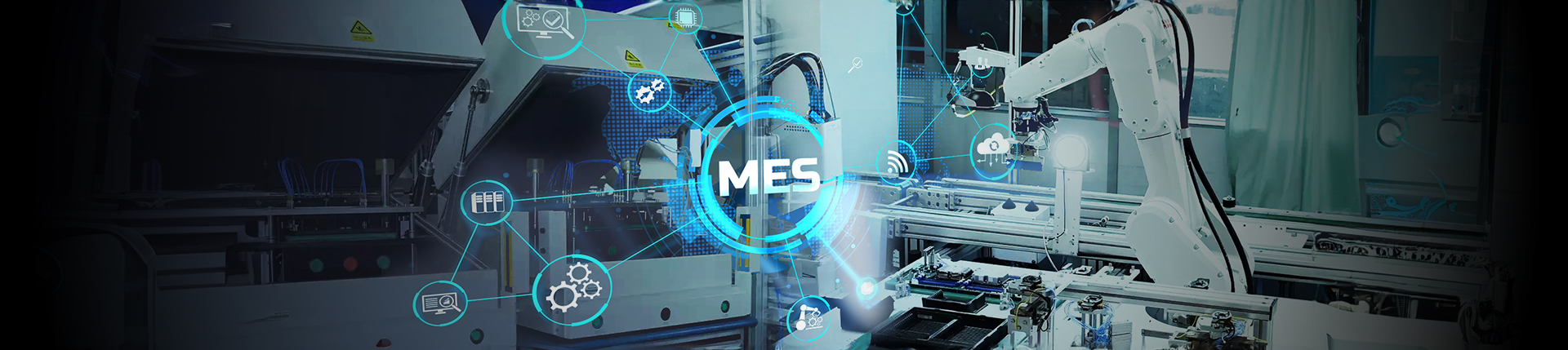
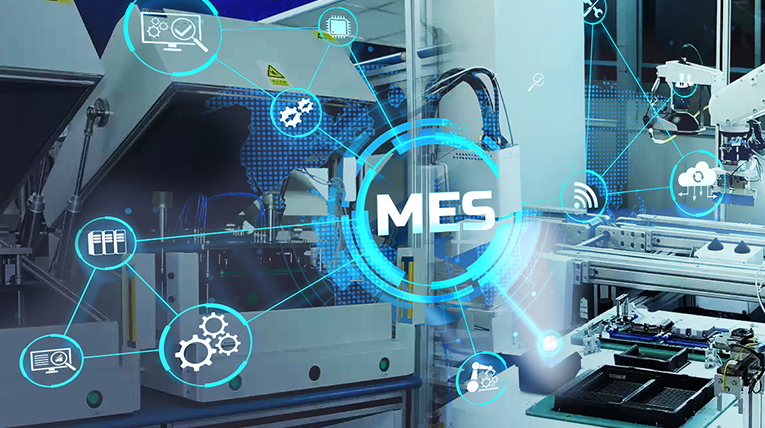
Table of Contents
The Rise of Intelligent Manufacturing
Manufacturing is no longer just about throughput and cost efficiency. Across the world, factories are being reimagined as intelligent, connected environments where decisions are driven by real-time data rather than static processes.
The numbers reflect this shift. As per PwC, the global industrial automation market is projected to more than double over the next decade, crossing $600 billion, while factory automation continues to grow at double-digit rates. More importantly, a large majority of manufacturers are actively investing in smart factory initiatives, signaling a clear move from traditional automation toward intelligence-led operations.
What is changing is not just the level of automation, but the way systems interact. Robotics, Automated Test Equipment ( ATE) infrastructure, and Manufacturing Execution Systems (MES) are no longer independent layers. When engineered together, they create a tightly integrated environment where production, quality, and decision-making continuously influence each other.
What Actually Makes a Factory “Smart”
A smart factory is less about machines and more about how everything connects and responds. Instead of operating in silos, modern factories rely on systems that can share data and continuously improve processes.
On the shop floor:
- Robotic systems execute tasks with precision, consistency, and increasing adaptability.
- ATE platforms that validate quality throughout production rather than only at final inspection.
- MES platforms orchestrate workflows, track production, and ensure end-to-end traceability.
The common thread connecting these elements is data.
Every robotic action, machine parameter, and ATE test result feeds into a centralized intelligence layer. This visibility enables manufacturers to transition from reactive problem-solving to predictive and preventive operations — reducing downtime, improving yield, and enhancing product quality.
Engineering the Integration of Robotics, Test Systems and MES
The real transformation begins when these three pillars are engineered as a unified system rather than deployed independently.
Robotics: From Automation to Adaptability
Modern robotics has evolved far beyond repetitive motion. Today’s systems are increasingly:
- Vision-enabled
- AI-assisted
- Flexible for high-mix production environments
This adaptability is especially critical in industries such as electronics, food & beverage, and automotive, where product configurations frequently change.
ATE Systems: Quality Embedded into Production
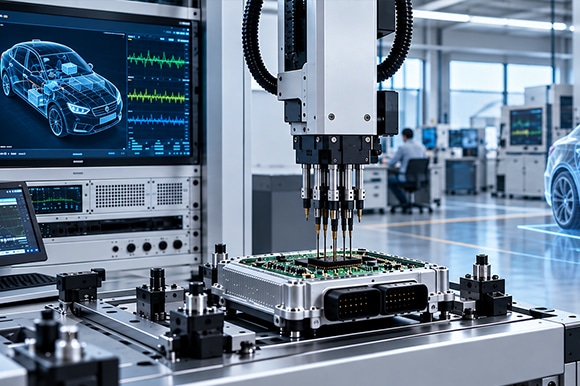
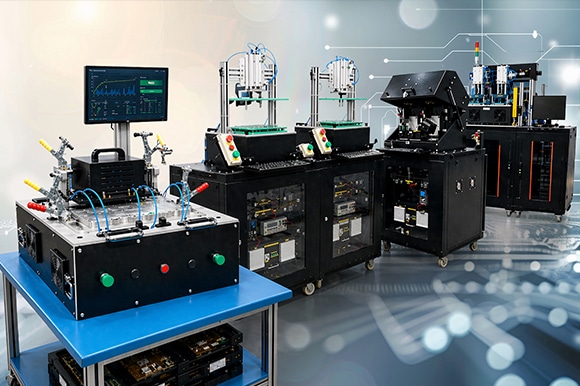
Automated Test Equipment (ATE) is no longer a downstream checkpoint. Instead, it has become an integral component of the manufacturing flow.
Inline testing and automated inspection now enable:
- Real-time defect detection
- Immediate corrective actions
- Reduced rework and scrap
- Higher first-pass yield
Quality assurance shifts from validation after production to assurance during production.
MES: The Digital Backbone
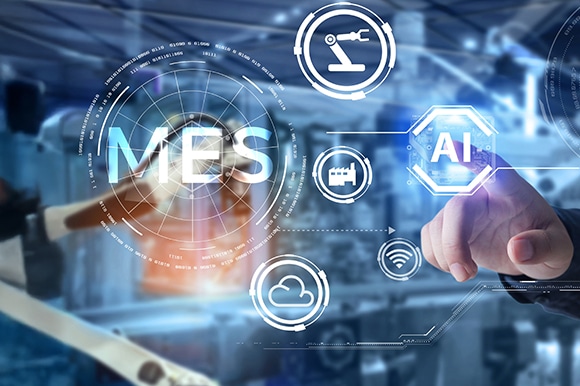
MES serves as the orchestration layer connecting machines, operators, and enterprise systems.
An effectively integrated MES enables:
- Lifecycle tracking of every unit produced
- Real-time production visibility
- Workflow orchestration across lines
- Data-driven process optimization
When MES is tightly integrated with robotics and test systems, a continuous feedback loop emerges:
- ATE test results influence robotic adjustments
- Production data drives process optimization
- Quality insights improve future runs automatically
Key Elements of Successful Integration
Engineering this convergence typically involves:
• Real-time communication between machines and MES using industrial protocols
• Synchronization of ATE data with production workflows
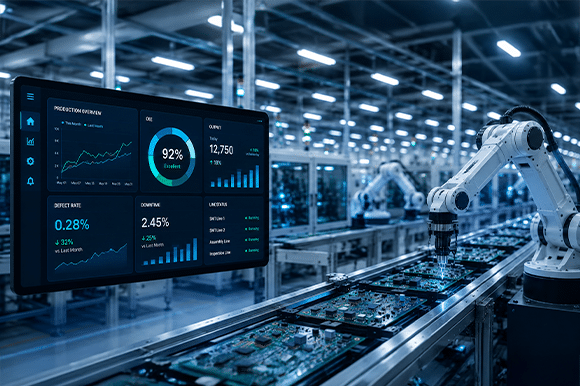
• Centralized dashboards for monitoring performance and quality
The result is a closed loop system where production is constantly refined based on actual performance rather than predefined assumptions.
From Connected Factories to Autonomous Operations
The next phase of manufacturing evolution is already taking shape. Factories are moving beyond connected systems toward autonomous operations where decision-making is increasingly handled by intelligent algorithms.
Advancements in AI, edge computing, and digital twins are enabling manufacturers to simulate, predict, and optimize production in ways that were not possible before. Production lines are becoming more self-correcting, capable of adjusting parameters in real time based on test results and operational data.
What lies ahead is not just smarter factories, but factories that can learn, adapt, and continuously improve with minimal human intervention.
How VVDN Supports Intelligent Factory Automation
At VVDN, we work with global manufacturing companies to engineer and deploy intelligent automation solutions that go beyond conventional approaches. By combining expertise in product engineering, manufacturing, and automation, we help integrate robotics, automated test systems, and MES into cohesive, high-performance production environments.
Our approach focuses on building scalable architectures, enabling real-time data visibility, and embedding quality directly into the manufacturing process. From designing automated production lines to implementing advanced ATE test solutions and integrating MES, VVDN supports manufacturers in transforming their operations into connected, future-ready factories.
As the shift toward intelligent manufacturing accelerates, the ability to seamlessly integrate systems and extract actionable insights from data will define competitive advantage. This is where VVDN partners with enterprises to turn automation into true manufacturing intelligence.
Know more about our production automation offerings HERE.